New since July 1, 2026
Does Medicare Cover Wegovy in 2026?
Yes, since July 1, 2026, at a flat $50 a month, through a temporary program called the Medicare GLP-1 Bridge. This is new. For years Part D was barred from paying for weight-loss drugs, and most of what you will find online still says no.
The rules have one feature that catches people out, and it is the opposite of how every commercial plan works: the medical conditions that normally unlock GLP-1 coverage will disqualify you from the Bridge. We archived Medicare's own coverage page on July 25, 2026; everything below quotes it.
- Covered under the Bridge: Wegovy injection or tablet, Foundayo tablet, and Zepbound KwikPen only.
- Flat $50 monthly copay, nationwide, all states and territories.
- Three BMI doors: 35+, or 30+ with one listed condition, or 27+ with another.
- Type 2 diabetes, moderate-to-severe sleep apnea and fatty liver disease make you ineligible for the Bridge — though regular Part D may cover you instead.
- Not eligible? Branded Wegovy is available cash-pay without a coverage decision. Compare what programs actually charge in our provider matcher. How we make money.
Does Medicare cover Wegovy?
Yes. Starting July 1, 2026, Medicare covers Wegovy for weight management through the GLP-1 Bridge, at a $50 monthly copay, if you have Part D drug coverage and meet the criteria. It is a temporary program, not a permanent change to the Part D statute.
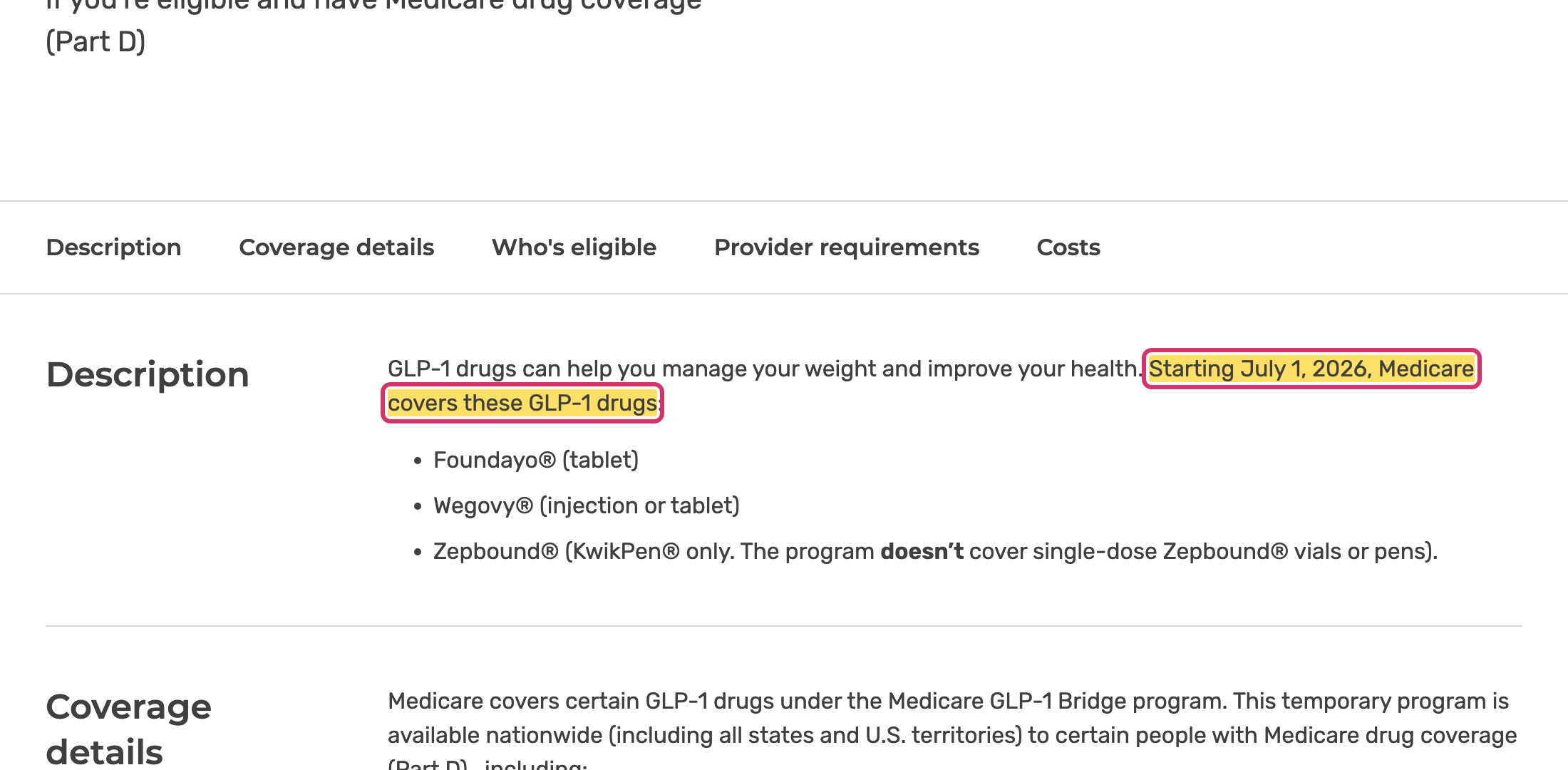
Which plan you hold matters less than people expect. The Bridge reaches standalone drug plans (PDP), Medicare Advantage plans with drug coverage (MA-PD, including HMO, HMOPOS and both Local and Regional PPO), Special Needs Plans, employer and union group waiver plans, and the Limited Income Newly Eligible Transition program. If you have Part D in any of those forms, you are inside the program's reach.
What is narrower than the headline suggests is the drug list. Wegovy is covered as either the injection or the tablet. Zepbound is covered only as the KwikPen. Medicare's page states the program does not cover single-dose Zepbound vials or pens. Foundayo is covered as a tablet. Everything else is outside the Bridge.
Who qualifies: the three BMI doors
You must be 18 or older and meet one of three thresholds when you start GLP-1 therapy. The tiers step down as the listed conditions get more serious.
| Your BMI | What else you need |
|---|---|
| 35 or higher | Nothing further |
| 30 or higher | One of: diastolic heart failure (heart failure with preserved ejection fraction), uncontrolled high blood pressure, or chronic kidney disease at stage 3a or higher |
| 27 or higher | One of: prediabetes, a previous heart attack or stroke, or symptomatic peripheral artery disease (blocked arteries in the legs or arms) |
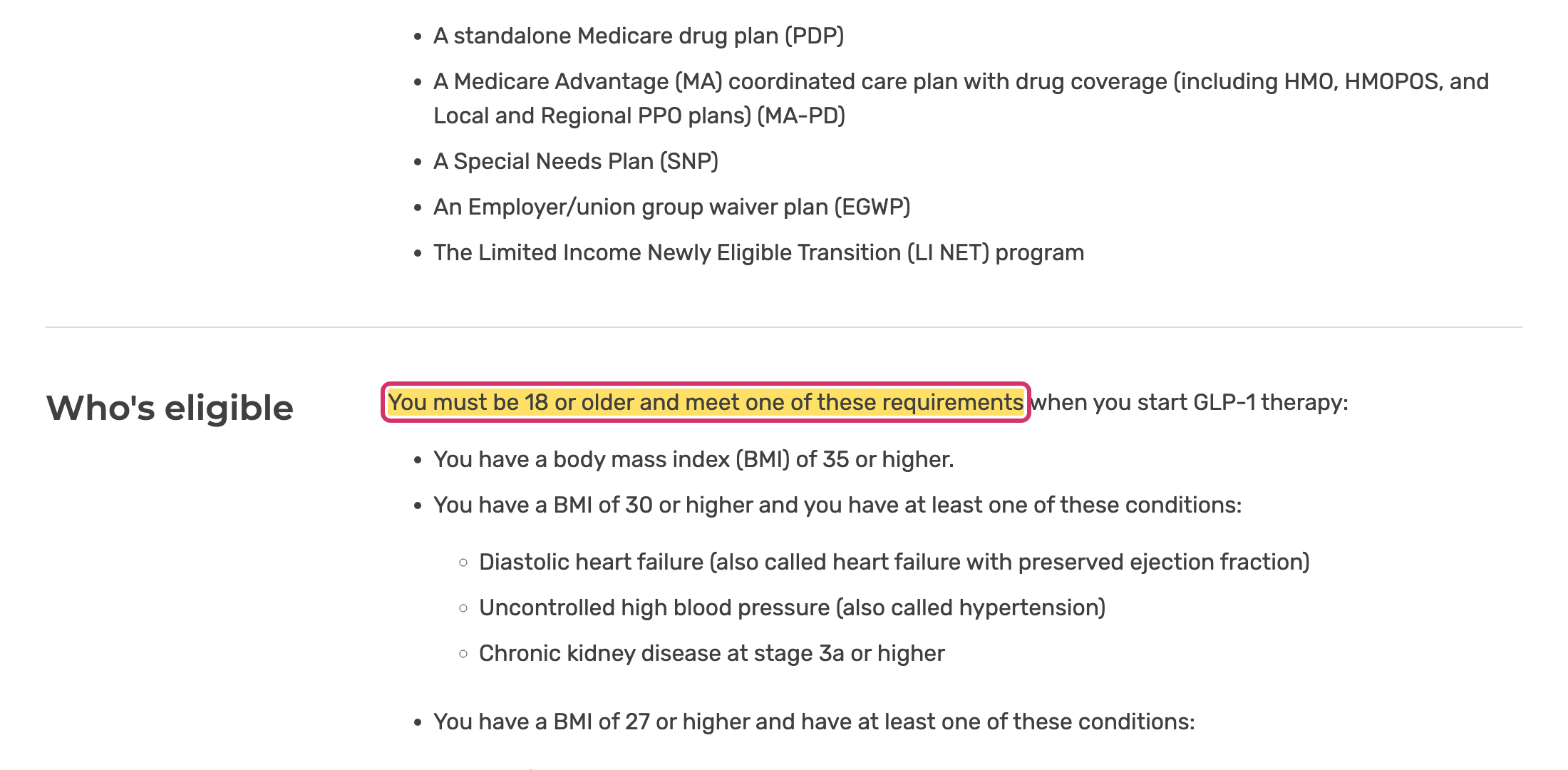
Two things worth noticing. Prediabetes qualifies at BMI 27, a wider door than most commercial plans open, and it is the tier most people miss. And the BMI that counts is your BMI at the start of therapy, not today's, which matters if you have already lost weight on something else.
The conditions that disqualify you
Here is the part that trips people up. Having a serious weight-related condition does not always help you. Three of them rule you out of the Bridge entirely.
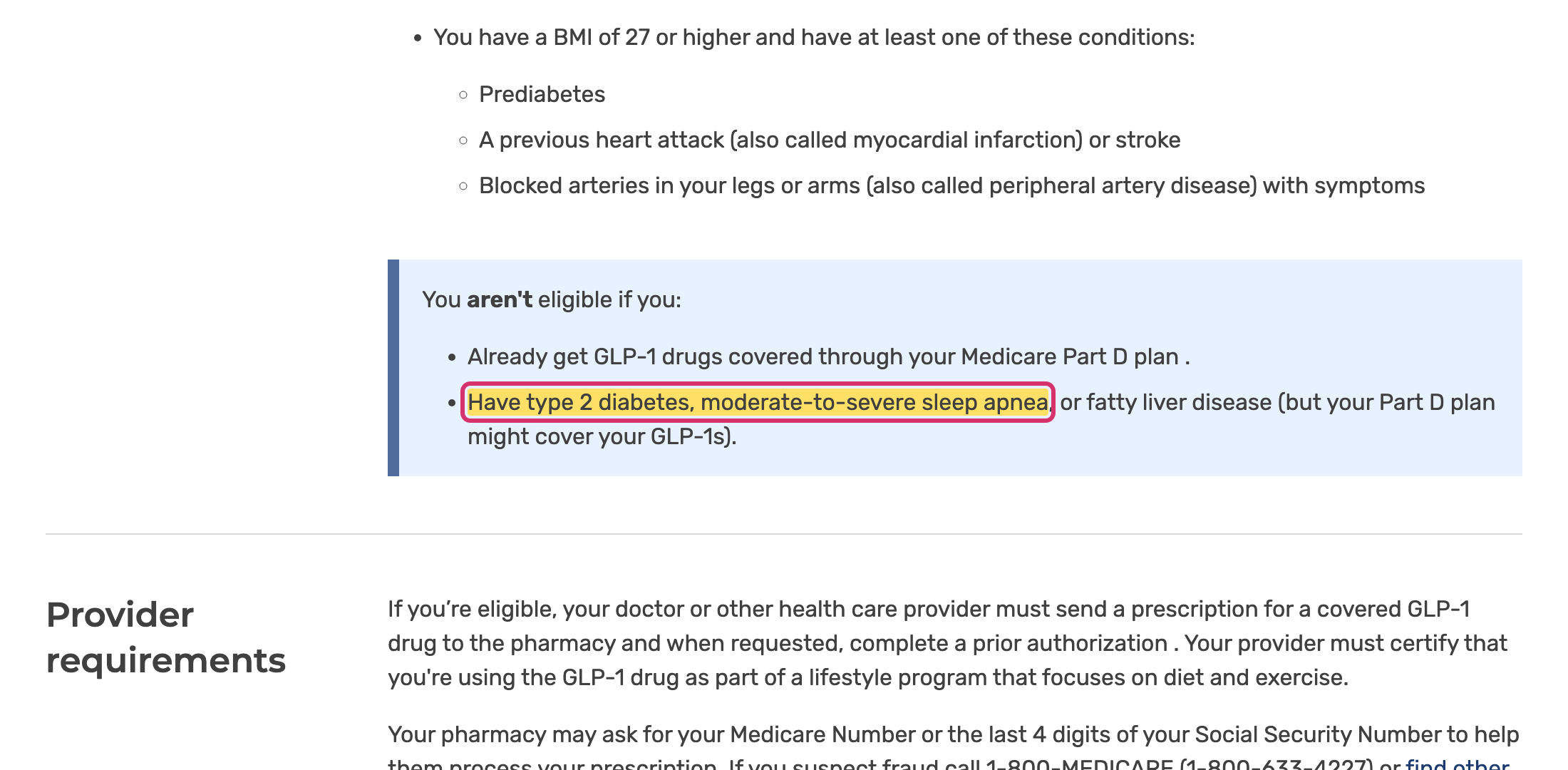
You are not eligible for the Bridge if you already get GLP-1 drugs covered through your Part D plan, or if you have type 2 diabetes, moderate-to-severe obstructive sleep apnea, or fatty liver disease.
Read the parenthetical on that second bullet, because it changes the whole picture: "but your Part D plan might cover your GLP-1s." The logic is not that Medicare thinks you are undeserving. It is that those three conditions are already FDA-approved indications with their own Part D pathways, so the Bridge, built for weight management specifically, steps aside. If you have one of them, your route is a standard Part D claim, not the Bridge. That is a different form, a different criteria set, and often a different copay.
If neither doorway is open to you, that is worth knowing today rather than after a denial letter. Branded Wegovy is sold cash-pay with no coverage decision involved: Ro Body lists the pill from $149 and the pen from $199 with membership billed separately, checked July 15, 2026, and our provider matcher ranks it against every other program we have verified. How we make money.
This is the single most useful thing to establish before your prescriber writes anything, because sending a Bridge request for a patient with type 2 diabetes produces a denial that looks like a rejection of the drug when it is really a rejection of the doorway.
Does Medicare cover Wegovy pills?
Yes. Medicare's list names Wegovy as covered in "injection or tablet" form, so the oral version is inside the Bridge on the same $50 copay. That is unusual: the tablet is new enough that most commercial plan documents have not caught up with it, and our Aetna and Wegovy guide found that none of Aetna's three published Wegovy policies mentions a tablet at all.
Foundayo, the other tablet on the list, is covered too. Zepbound is the one to watch: KwikPen only, with vials and single-dose pens excluded by name.
What your prescriber has to certify
Two requirements sit on the provider side, and the second is the one that generates surprise denials.
Your doctor sends the prescription for a covered GLP-1 to the pharmacy and, when the plan asks, completes a prior authorization. Beyond that, Medicare requires the provider to certify that you are using the drug as part of a lifestyle program focused on diet and exercise. That certification is not optional and not automatic. It is a statement your prescriber has to be willing to make, so raise it at the appointment rather than discovering it after a rejection.
At the counter, the pharmacy may ask for your Medicare Number or the last four digits of your Social Security Number to process the claim. Medicare's guidance is explicit that if you suspect fraud you should call 1-800-MEDICARE directly rather than give details to anyone who contacted you first.
If the Bridge says no: Part D, and what it costs
A Bridge denial is not the end of the road, and which fallback applies depends on why you were turned down.
| Your situation | Route | What you pay |
|---|---|---|
| Eligible under a BMI tier | GLP-1 Bridge | $50/month flat |
| Type 2 diabetes, moderate-to-severe sleep apnea, or fatty liver disease | Standard Part D claim on that indication | Your plan's tier copay |
| Already covered for GLP-1s by your Part D plan | Stay where you are — the Bridge is closed to you | Your plan's tier copay |
| Neither door opens | Cash-pay | Varies widely by program |
One thing to know about the manufacturer savings card that comes up in every Wegovy discussion: it excludes people on Medicare, Medicaid and TRICARE by its own terms. The "$25 a month" figure circulating online is a commercial-insurance offer and it is not available to you. If you land in the bottom row, the honest comparison is between cash-pay programs, and the number that decides it is almost never the advertised headline — it is the membership fee stacked on top. Ro Body publishes branded Wegovy at $149 for the pill and $199 for the pen with membership billed separately, prices checked July 15, 2026. Our cost calculator adds those fees back in and the provider matcher ranks what is left. Provider links here are affiliate links, and this is how that works.
Where to check before you go to the pharmacy
Three checks, in order, and each answers something the previous one cannot.
- Confirm you hold Part D in a qualifying form. PDP, MA-PD, SNP, EGWP or LI NET all count. A Medicare Advantage plan without drug coverage does not.
- Establish which doorway you are in before the prescription is written — Bridge or standard Part D. If you have type 2 diabetes, sleep apnea or fatty liver, it is the second one, and asking for the Bridge will waste weeks.
- Ask your prescriber directly whether they will sign the lifestyle-program certification. It is a yes-or-no question, better answered in the room than at the pharmacy counter.
If step one or two rules you out, price the cash route before you start appealing anything — our provider matcher shows every fee separately, which is where advertised prices usually hide the difference. How we make money.
FAQ
How do I get Medicare to pay for Wegovy?
Confirm you have Part D, check you meet one of the three BMI tiers, and make sure you do not fall into the exclusions. Your prescriber then sends the prescription, completes any prior authorization, and certifies that you are using the drug alongside a diet-and-exercise program.
Will Medicare pay for Wegovy pills in 2026?
Yes. Medicare's covered-drug list names Wegovy in injection or tablet form, both at the $50 Bridge copay. Foundayo tablets are also covered; Zepbound is limited to the KwikPen.
Does Medicare cover Wegovy for sleep apnea?
Not through the Bridge. Moderate-to-severe sleep apnea is an explicit disqualifier. Medicare's own note says your Part D plan might cover a GLP-1 on that indication instead, which is a standard Part D claim rather than a Bridge request.
Does Medicare cover Wegovy for prediabetes?
Yes, if your BMI is 27 or higher. Prediabetes is one of the three conditions listed under the lowest BMI tier, which makes it a wider door than many commercial plans offer.
Which weight loss drugs are covered by Medicare?
Under the Bridge: Foundayo tablets, Wegovy injection or tablet, and Zepbound KwikPen. Single-dose Zepbound vials and pens are excluded by name, and no other weight-management GLP-1 is on the list.
Sources and update history
Primary documents, archived July 25, 2026: Medicare.gov — Weight loss drugs coverage; Medicare publication 12234, "GLP-1 Drugs for $50 a Month" (June 20, 2026). The Bridge is a temporary program and its drug list and criteria can change, so verify against the linked pages before acting. Our companion pages: Medicare and Zepbound, Aetna and Wegovy.