Two coverage doors: the $50 Bridge, or Part D for sleep apnea
Does Medicare Cover Zepbound in 2026?
Yes — through two different doors, and picking the right one decides whether your claim goes through. For weight loss, Medicare Part D still can't pay by law, but since July 1, 2026 the Medicare GLP-1 Bridge covers Zepbound KwikPen at a flat $50 a month for Part D enrollees who meet BMI criteria. For moderate-to-severe obstructive sleep apnea, Zepbound can be covered by your regular Part D plan — that's an FDA-approved indication that isn't weight loss, so the legal exclusion doesn't apply.
We archived the CMS program page and the CMS prescriber guidance (Product No. 12235) on July 22, 2026, and everything below quotes those documents — including the two operational details most articles skip: the E66 diagnosis code and the routing note your prescriber must put on the prescription. Which door fits you:
| GLP-1 Bridge (weight loss) | Part D (sleep apnea) | |
|---|---|---|
| Who it's for | Part D enrollees, BMI criteria below, no diabetes/OSA/MASH diagnosis | Diagnosed moderate-to-severe OSA with obesity |
| What's covered | Zepbound KwikPen only (also Wegovy, Foundayo) | Whatever your plan's formulary lists — typically with PA |
| Your cost | $50/month flat | Your plan's tier copay; counts toward the Part D out-of-pocket cap |
| Runs through | CMS central processor, outside your plan | Your normal Part D plan |
| Ends | December 31, 2027 | Ongoing |
Does Medicare cover Zepbound for sleep apnea?
Yes — and this is the door most people miss. The law that blocks Medicare from paying for weight-loss drugs is specific to weight-loss use. Zepbound is FDA-approved for moderate-to-severe obstructive sleep apnea in adults with obesity, and for that diagnosis a Part D plan can cover it like any other drug: on-formulary, usually behind a prior authorization requiring a sleep study (typically an apnea-hypopnea index of 15 or more) and a BMI of 30 or higher.
Three practical implications. First, check your plan's formulary for Zepbound before assuming you need the Bridge — a Part D claim counts toward your annual out-of-pocket cap, and once you hit it your cost can drop below the Bridge's $50. Second, the diagnosis on the prescription is what routes the claim: if you have documented OSA, your prescriber should lead with it. Third, if you're in the CMS Bridge instead, an OSA diagnosis actually makes you ineligible — CMS sends people with diabetes, moderate-to-severe OSA, or MASH to their Part D plan, because Part D can already cover those uses. One diagnosis, one door.
The GLP-1 Bridge: how to actually use it
The Bridge is a CMS demonstration running July 1, 2026 through December 31, 2027 that pays for GLP-1 weight-loss prescriptions outside of Part D, through a central processor. Eligibility, quoted from the CMS prescriber guidance: you're enrolled in Part D (a few plan types are excluded — PACE, cost contract, private fee-for-service — unless you also have a standalone drug plan), you haven't already gotten a GLP-1 through your Part D plan, you don't have type 2 diabetes, moderate-to-severe OSA, or MASH, you're 18 or older, and you meet one of three BMI tiers:
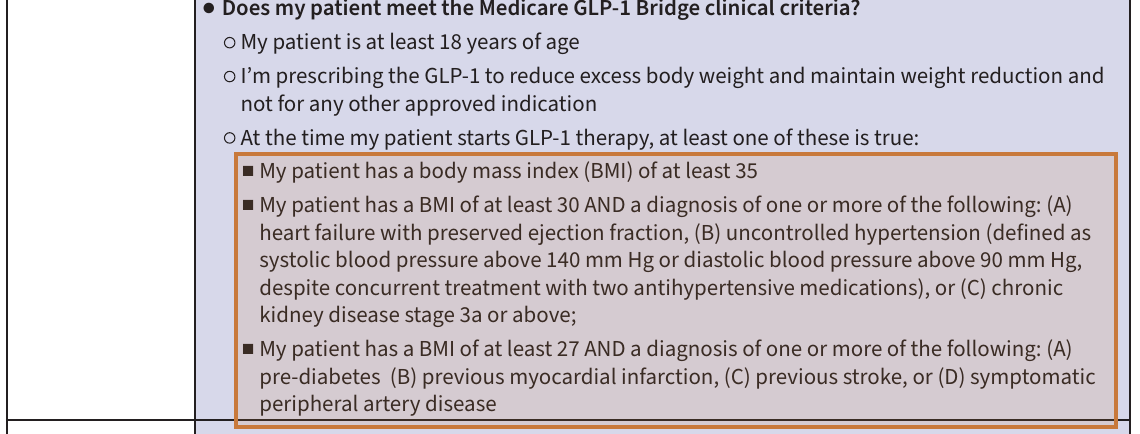
- BMI ≥ 35 — no other conditions needed.
- BMI ≥ 30 plus one of: heart failure with preserved ejection fraction, uncontrolled hypertension (above 140/90 despite two medications), or chronic kidney disease stage 3a or above.
- BMI ≥ 27 plus one of: pre-diabetes, previous heart attack, previous stroke, or symptomatic peripheral artery disease.
Two timing details from the CMS wording are easy to miss. The BMI tiers are measured "at the time my patient starts GLP-1 therapy" — so if you qualified when you began the medication, later weight loss doesn't disqualify your renewals; make sure the starting BMI is in your chart. And there is no application or enrollment form for patients: eligibility is confirmed automatically when the pharmacy claim reaches the CMS processor, which also checks Medicare's own data (the prescriber attests to the clinical criteria under penalty of perjury, and CMS states it may verify against Medicare records). Your job is the prescription details; the system does the rest.
And the detail that trips up more fills than any criterion: the Bridge covers Zepbound KwikPen only. CMS states it plainly — "The single-dose Zepbound pen and Zepbound vials are NOT covered." If you're currently on the single-dose autoinjector pens or vials (including from a telehealth program), your prescriber needs to rewrite the prescription for the KwikPen, Lilly's multi-dose pen. Same drug, same doses — but a different NDC, and the Bridge processor rejects the wrong one. This also matters if you're coming from a telehealth program selling compounded tirzepatide: compounded products aren't Zepbound and are never Bridge-eligible, so the move is a fresh prescription for the branded KwikPen, at whatever dose your clinician confirms — not a transfer.

Part D: what it can and can't pay for
The statutory rule hasn't changed: Part D plans are prohibited from covering drugs used for weight loss, and the Bridge doesn't change Part D — it routes around it. What Part D can cover is Zepbound for OSA (above), and its sibling molecules for their non-weight indications: Mounjaro (same tirzepatide, diabetes label) for type 2 diabetes, and Wegovy for cardiovascular risk reduction and MASH. That's why two neighbors on the same Part D plan can get opposite answers about "the same drug" — the diagnosis, not the molecule, decides.
One history note so older articles don't confuse you: the previously announced BALANCE model — which would have let Part D plans opt in to obesity coverage starting 2026 — was cancelled for Medicare in April 2026 and replaced by the Bridge demonstration. If a page talks about plans "opting in" to weight-loss coverage, it's describing the dead proposal, not the live program.
Coverage for heart disease
Zepbound itself has no cardiovascular indication on its label — so unlike Wegovy, it can't go through Part D "for heart disease." But heart conditions still matter for Zepbound on Medicare, because they unlock the Bridge's lower BMI tiers: heart failure with preserved ejection fraction qualifies you at BMI 30, and a previous heart attack, stroke, or symptomatic peripheral artery disease qualifies you at BMI 27. If your cardiologist has ever documented one of these, that chart note is the difference between qualifying and not.
If cardiovascular risk reduction is itself the treatment goal, ask your clinician about Wegovy instead — its label carries the indication, both the Bridge and Part D recognize it, and Medicare's coverage doors open wider for it.
What you'll pay: the $50 Bridge copay
The Bridge charges a flat $50 per month — with two catches the headline number hides. Bridge payments run outside Part D, so they do not count toward your Part D deductible or the annual out-of-pocket cap; and only 28- or 30-day fills are covered, so there's no 90-day discount. Against the alternatives as of July 2026:
| Path | Your monthly cost | Notes |
|---|---|---|
| GLP-1 Bridge (weight loss) | $50 flat | KwikPen only; doesn't count toward Part D deductible or cap |
| Part D with OSA diagnosis | Plan tier copay | Counts toward the out-of-pocket cap; PA with sleep study typical |
| Cash pay, telehealth programs | ~$299–$449 + program fees | Verified fee breakdowns on our provider comparison |
| Cash pay, retail list price | ~$1,000–$1,400 | The price nobody should pay |
At $600 a year, the Bridge beats every cash-pay route by hundreds of dollars a month. The planning question is the end date: the demonstration runs through December 31, 2027, and CMS hasn't said what follows. Stopping a GLP-1 abruptly commonly leads to weight regain, so it's fair to ask your clinician at the start what the plan is if the program isn't renewed — our cost calculator shows what a cash-pay transition would cost at your dose.
If the pharmacy rejects the claim
Bridge claims fail in predictable ways, because the routing is manual. The prescription must carry an obesity diagnosis code (the E66 family) and the exact note "SEND TO BRIDGE FOR WEIGHT MANAGEMENT" — CMS's words — in the Note field if electronic, or as an annotation if not. Without that direction, the pharmacist sends the claim to your Part D plan, which rejects it or starts the wrong prior authorization.
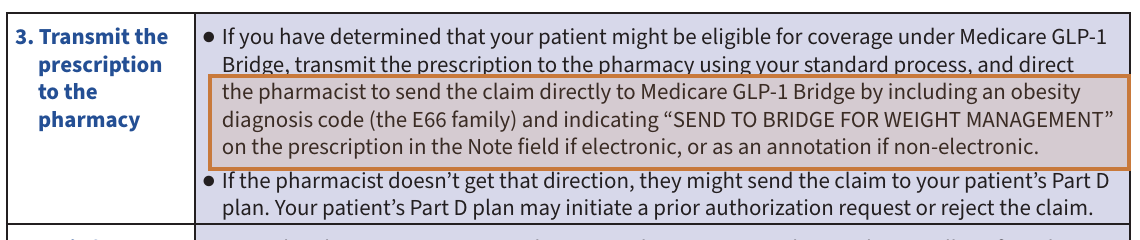
The full flow, so you know what "normal" looks like: the first Bridge claim is designed to deny — that denial triggers the processor to send a prior-authorization form to your prescriber, typically within 24–72 hours. Your prescriber completes it (or downloads the fax form from cms.gov/glp-1-bridge.pdf if nothing arrives within 72 hours), and approval or denial comes back within 72 hours of submission. After the first approved fill, refills need no new prior authorization — unless you switch to a different covered GLP-1, which restarts the process.
So if your fill bounces: confirm the E66 code and routing note are on the prescription, confirm it's written for KwikPen, and ask the pharmacist whether the claim went to the Bridge processor or to your Part D plan. Those three checks resolve most rejections. If a denial looks wrong, CMS allows resubmission for re-review — there's no formal appeal, but re-review with corrected documentation works.
FAQ
Does Medicare cover Zepbound for weight loss?
Not through Part D — that's barred by law. But the Medicare GLP-1 Bridge covers Zepbound KwikPen at $50/month for weight loss from July 1, 2026 through December 31, 2027, for Part D enrollees meeting BMI criteria (35+; or 30+/27+ with specific conditions).
Does Medicare Part D cover Zepbound in 2026?
Only for obstructive sleep apnea, where plan formularies can list it with prior authorization. For weight loss, Part D can't pay; the Bridge exists precisely to route around that.
Do Medicare Advantage plans cover Zepbound?
Same rules: the drug side of a Medicare Advantage plan is Part D, so weight-loss use goes through the Bridge and OSA can go through the plan. The Bridge is open to MA-PD enrollees — the claim just runs through the CMS processor instead of your plan.
Are Zepbound vials or single-dose pens covered by the Bridge?
No. CMS covers only the Zepbound KwikPen; "the single-dose Zepbound pen and Zepbound vials are NOT covered." Ask your prescriber to write the KwikPen NDC.
Does the $50 Bridge copay count toward my Part D out-of-pocket cap?
No. The Bridge runs outside Part D, so its payments don't touch your deductible or the annual cap. An OSA claim through Part D does count.
What happens to Zepbound coverage after 2027?
Unknown. The Bridge demonstration ends December 31, 2027, and CMS hasn't announced a successor. Plan for the cliff with your clinician; we track changes on this page and our coverage checker.
Sources and update history
Primary documents, archived in our research records on July 22, 2026: CMS Medicare GLP-1 Bridge program page; CMS "Medicare GLP-1 Bridge — Information for Prescribers" (Product No. 12235, June 2026), the source for the eligibility tiers, KwikPen restriction, E66/routing requirement, and 72-hour timelines. Program terms can change — verify against the CMS pages and your plan documents.