Three policy documents, one gate
Does Aetna Cover Wegovy in 2026?
Usually yes, with prior authorization, unless your employer excluded weight-loss drugs from the plan. Wegovy stayed on Aetna's standard formulary when Zepbound came off it in July 2025, so the question is rarely "is it listed." It is whether you can document the thing Aetna's policy actually asks for: six months in a weight-management program before the prescription.
We archived Aetna's three published Wegovy policies and its obesity-exclusion bulletin on July 25, 2026. Everything below quotes those documents.
- Wegovy is on Aetna's standard commercial formulary, with prior authorization. It was not removed alongside Zepbound.
- The gate most people fail is the 6-month prior program requirement, not the BMI threshold.
- Renewal needs 5% baseline weight loss documented at 3 months. A chart note, not a home scale.
- If your plan carves out obesity treatment entirely, no prior authorization can succeed. That is a different problem with a different fix.
- Not covered, or denied? Compare what cash-pay programs actually charge with our provider matcher before you pay retail. How we make money.
Does Aetna cover Wegovy?
On most Aetna commercial plans, yes: Wegovy is covered with prior authorization. Three situations change that answer, and knowing which one you are in decides everything you do next.
| Your situation | Answer | What decides it |
|---|---|---|
| Standard commercial plan | Covered with prior authorization | Policy 4774-A or 4774-C criteria: the 6-month program plus BMI |
| Plan excludes obesity treatment | Not covered, and a PA cannot fix it | Your employer's benefit election, described in CPB 0039 |
| Medicare Part D | Not for weight loss; possible for cardiovascular risk reduction | Federal law, plus Aetna's Medicare GLP-1 Bridge |
| Aetna Better Health (Medicaid) | State by state | Your state Medicaid program's preferred drug list |
If you landed in row two, stop reading policy criteria. They do not apply to you. Skip to what to do when the plan excludes the whole drug class, or start pricing the cash route now: Ro Body publishes branded Wegovy at $149 for the pill and $199 for the pen, billed on top of membership, and our provider matcher ranks that against every other program we have verified. Provider links on this page are affiliate links, and this is how that works.
PPO, POS II, HMO, EPO: which plan types cover it
Plan type is not what decides coverage. Plan sponsor is. A PPO and an HMO from Aetna can land on opposite answers because two different employers made two different benefit elections. This is the single most common misunderstanding we see in the search data, where people search their exact plan name hoping it carries a universal answer.
What plan type does change is the process around the answer: referral requirements, in-network pharmacy rules, and who you call. The coverage decision itself lives in your employer's formulary election.
Meritain, Banner|Aetna, and the NC State Health Plan
Administered and joint-venture arrangements follow the sponsor's own drug list, not Aetna's standard one. Meritain Health administers self-funded employer plans; Banner|Aetna is an Arizona joint venture; the NC State Health Plan sets its own pharmacy benefit. If your card carries one of these names, the standard formulary above is a starting guess, not your answer. The plan document is.
Medicare, Medicare Advantage, and SilverScript
Medicare Part D cannot cover a drug used for weight loss. That is federal law, not an Aetna decision, and it applies to SilverScript and Aetna Medicare Advantage drug coverage equally. Two doors remain open. Wegovy prescribed to reduce cardiovascular risk in adults with established cardiovascular disease is a different, coverable indication. And Aetna's Medicare GLP-1 Bridge covers certain weight-loss GLP-1s at a flat copay, listing Wegovy in both injection and tablet form. Our Medicare Bridge breakdown walks the mechanics.
Aetna Better Health (Medicaid)
State-dependent, and most state Medicaid programs still exclude GLP-1s for obesity. Aetna Better Health publishes anti-obesity criteria per state. We have not yet archived the state-level Wegovy criteria documents, so we are not going to summarize them here. Check your state's preferred drug list directly.
Approval criteria: the 6-month program rule and the 5% checkpoint
Prior authorization is Aetna's pre-approval process: your prescriber submits documentation proving you meet the policy criteria before a pharmacy can fill the prescription. Aetna approves Wegovy when your prescriber documents two things: that you already spent six months in a comprehensive weight-management program, and that your BMI clears the threshold. The first one is where most requests die, because people start the program and the prescription at the same time.
Policy 4774-A states the initial criteria directly:
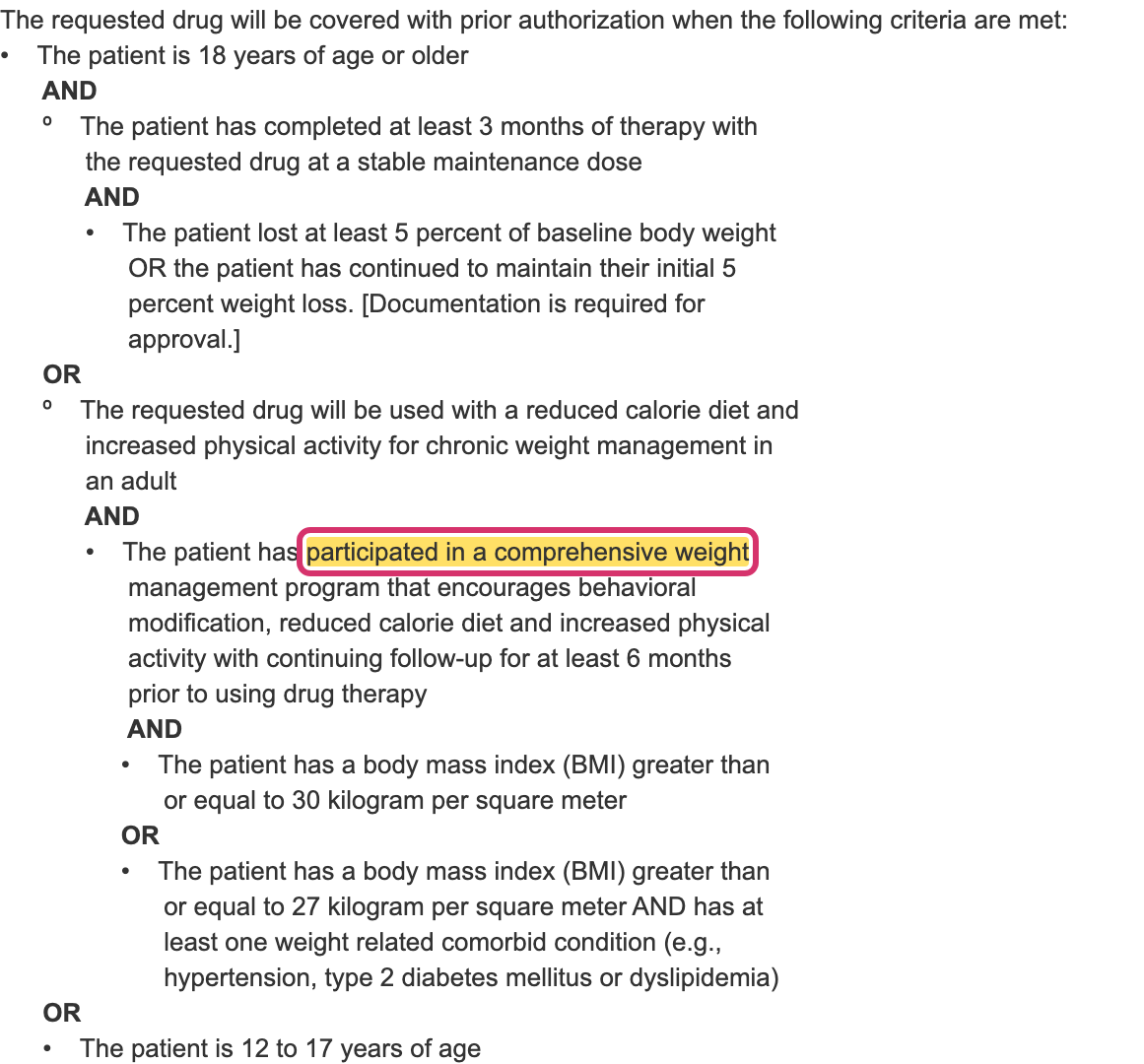
Read the sequencing carefully. The program must have "continuing follow-up for at least 6 months prior to using drug therapy." A program you enroll in the week your prescriber submits the request does not satisfy it. Alongside that, you need a baseline BMI of 30 or higher, or 27 or higher with at least one weight-related comorbid condition. The policy names hypertension, type 2 diabetes, and dyslipidemia as examples. There is a separate pathway for patients aged 12 to 17 at or above the 95th BMI percentile.
Continuation is a second, different test. To keep coverage past the initial authorization, the policy requires three months of therapy at a stable maintenance dose plus documented weight loss:
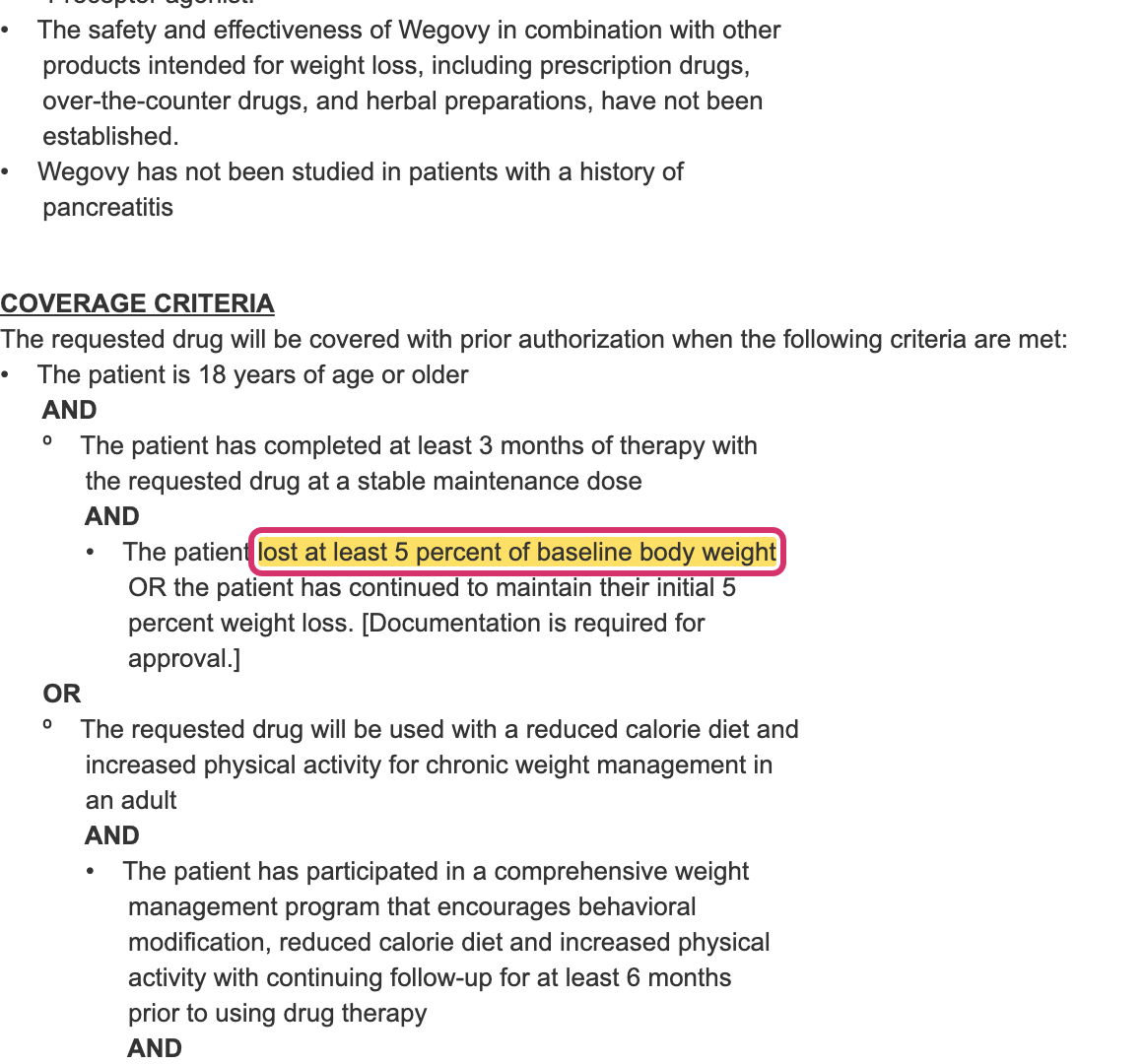
The renewal denials we see reported are rarely about the 5% itself. They are about the 5% not existing anywhere the insurer accepts. Ask for a weigh-in recorded in the chart at every visit from day one. A dated clinical note beats a screenshot of your bathroom scale.
If you read those criteria and realised you have no documented program history, that is worth knowing now rather than after a denial. Some readers start the six-month clock and use a cash-pay program in the meantime; our provider matcher filters programs by budget and by whether they help with prior-authorization paperwork, and the cost calculator adds the membership fees that advertised prices leave out.
Which policy applies: 4774-A or 4774-C
Aetna publishes three Wegovy policies at once, and they do not say the same thing. This matters if your prescriber is citing criteria from one while your plan administers another.
| Policy | Document date | Cardiovascular indication | Quantity limits |
|---|---|---|---|
| 4774-A 08-2022 v2 | March 15, 2023 | No | No |
| 4774-C UDR 08-2023 v2 | May 1, 2024 | Yes | Yes |
| 4774-C P08-2024_R | December 19, 2024 | Yes | Yes |
The six-month program requirement is identical in all three, so that gate is safe to plan around. What differs is the cardiovascular indication, which appears only in the 4774-C documents:
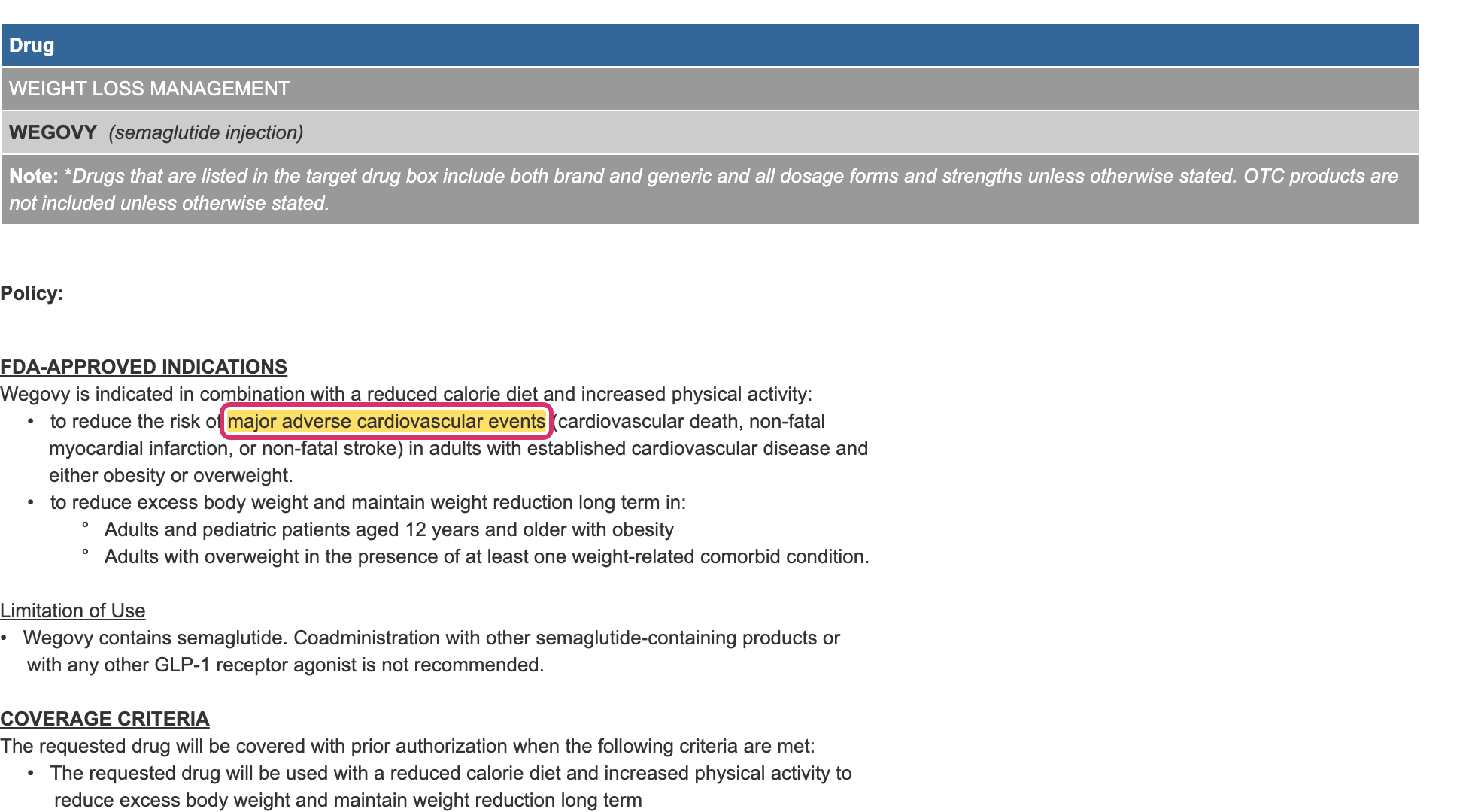
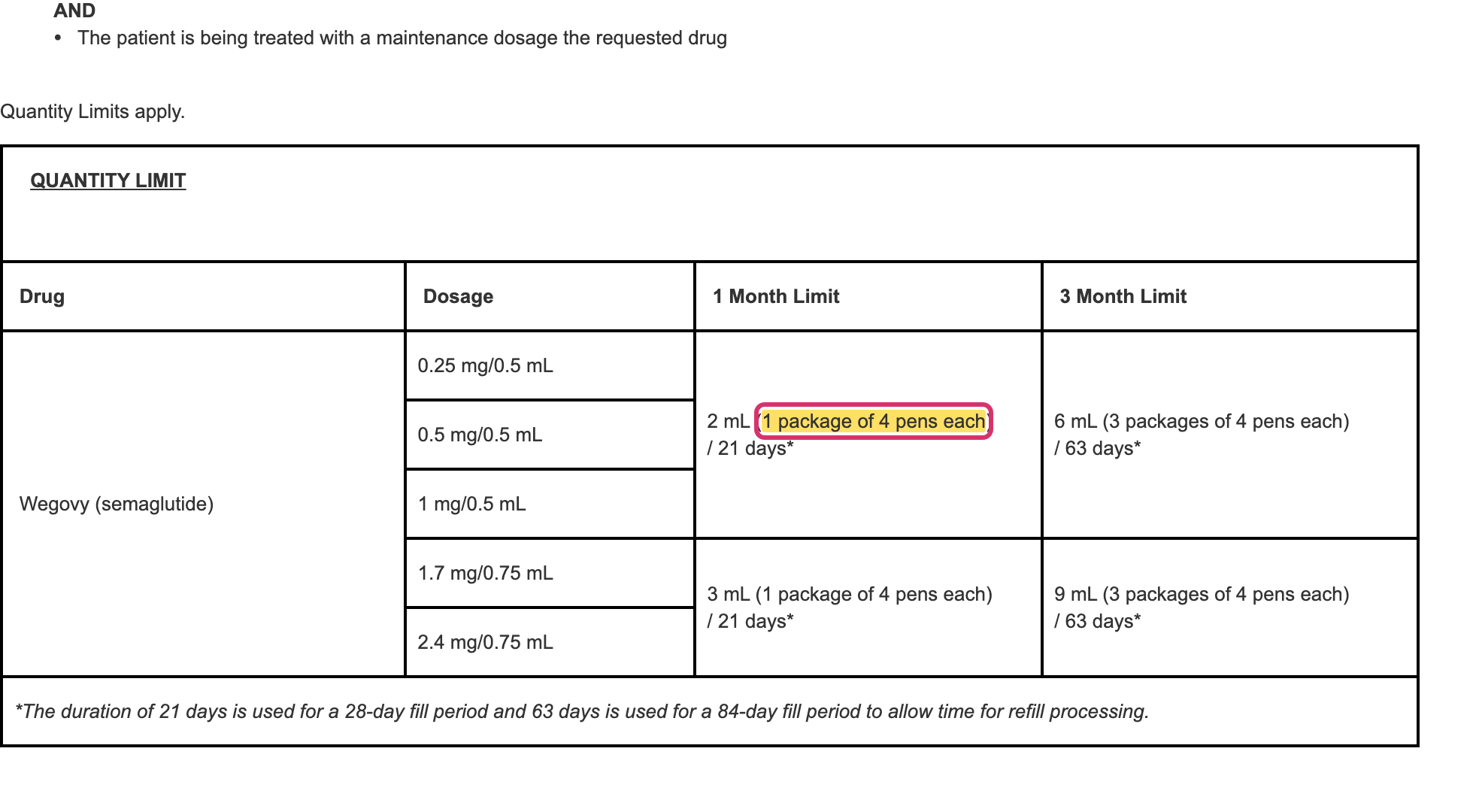
The 4774-C policies also cap how much you can fill and how often, which changes your refill calendar more than most people expect:
One honest gap worth naming: none of the three policies references Wegovy's metabolic liver disease (MASH) indication, which the FDA approved in August 2025. The newest Aetna commercial policy we could locate is dated December 2024. If you are pursuing coverage on that basis, the published criteria simply do not address it yet, and your prescriber will be arguing from the label rather than from an Aetna document.
CVS Weight Management, and the app you may have to enroll in
Aetna's weight-management wrapper is a CVS product, and on some plans enrolling in it is part of getting the drug. Members usually call the whole thing "Health Optimizer," which is actually the name of the app inside it.
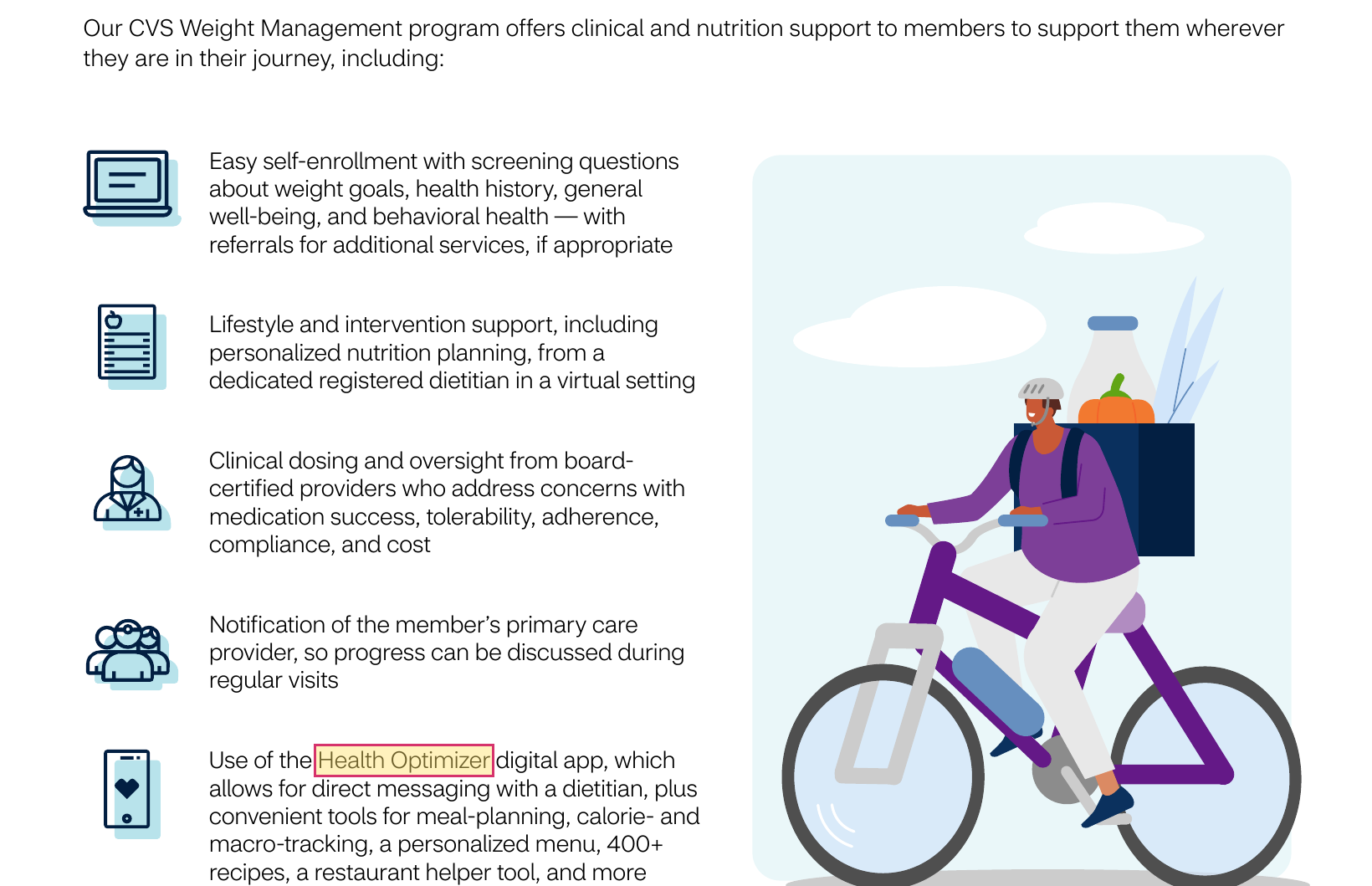
Two things follow from the fact that this is an employer-facing sales document. First, enrollment is not a blanket Aetna requirement. The same document asks plan sponsors whether they want to "put in extra requirements," which is exactly what a program-enrollment condition is. Whether it applies to you was decided by your employer. Second, the structure explains itself: Aetna, the pharmacy benefit manager reviewing your prior authorization, and the weight-management program you may be required to join are all CVS Health. Ask HR directly whether your plan attaches a program-participation condition to GLP-1 coverage; it is a yes-or-no question benefits teams answer routinely.
Why did Aetna deny my Wegovy?
Either your documentation fell short of the policy criteria, or your plan excludes obesity treatment altogether. Those are different denials with different fixes, and the letter tells you which one you got: a prior-authorization denial means the drug is covered but the paperwork was incomplete, while a benefit exclusion means no amount of paperwork will change the answer.
Aetna's Clinical Policy Bulletin 0039 states the exclusion plainly, and it is the sentence that decides more cases than any criteria list:
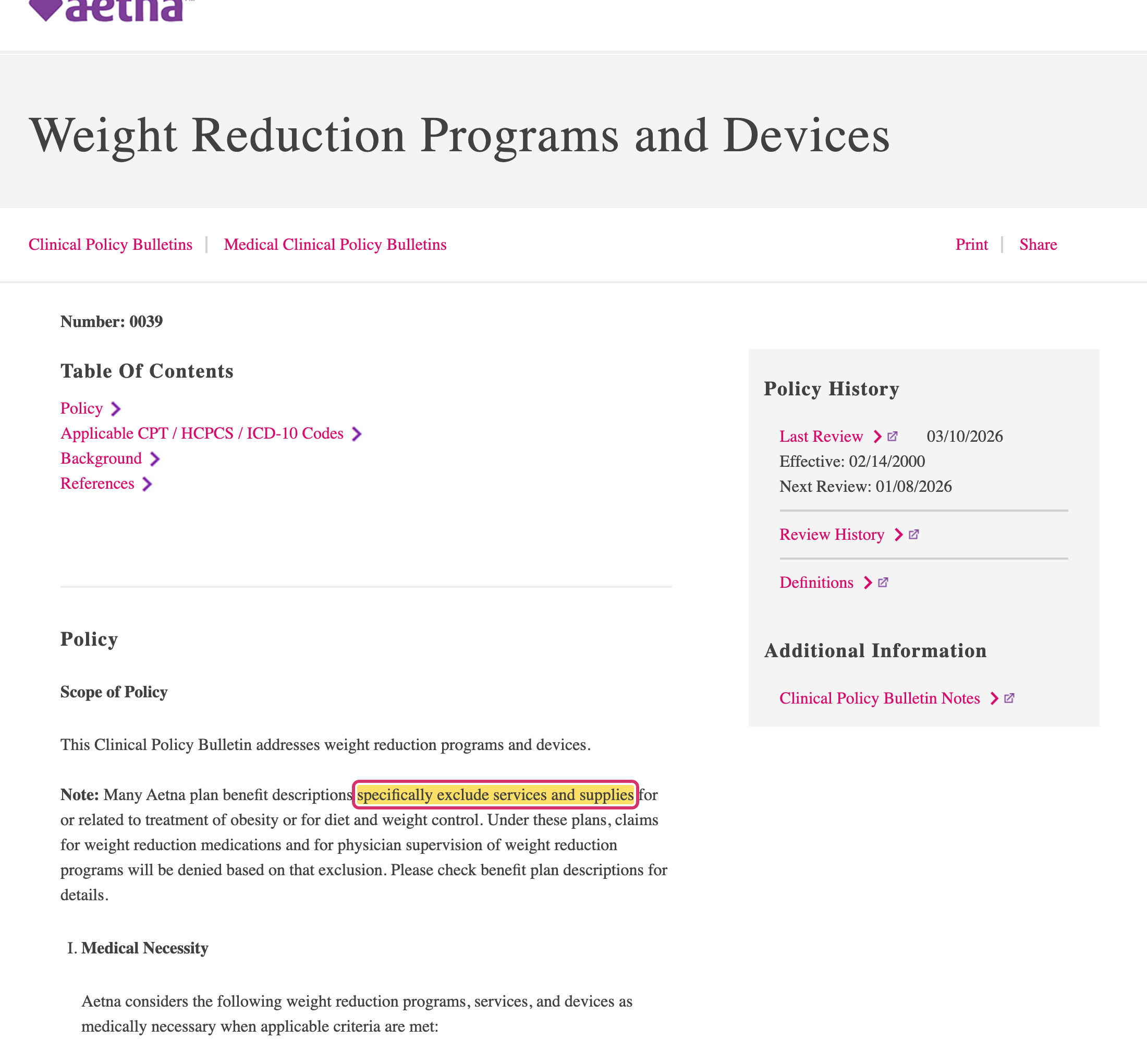
So the first move after any denial is to get the reason in writing and identify which one you are facing. For a PA denial, the fix is usually the missing piece: six-month program records, the baseline BMI chart note, or documentation of the 5% loss at renewal. File the internal appeal with that evidence attached; if it fails, every state gives you external review by an independent physician. For a benefit exclusion, appeals almost never work. The realistic routes are a formulary exception request arguing medical necessity, a different covered indication if one genuinely applies, or paying cash.
You will find claims online that a large majority of initial Wegovy denials get overturned on resubmission. The figure we saw most often, above 40%, traces to a plaintiff-side law firm that markets to denied claimants; we could not verify it against any primary source and would not plan around it. What we can say is narrower and more useful: resubmitting with the specific missing document is a materially different act from re-filing the same request, and the denial letter tells you which document is missing.
While an appeal runs, treatment gaps are real. If you want to price the parallel cash route rather than wait, our provider matcher filters programs by what they charge and whether they support prior-authorization paperwork, and several will keep working the insurance angle while you pay out of pocket. How we make money.
Programs that file the prior authorization for you
If the paperwork is your obstacle rather than the criteria, several telehealth programs run an insurance concierge that submits the prior authorization on your behalf. Below is what each one publishes, with the date we last verified its pricing. These are affiliate links; how we make money, and why it does not change what we write.
| Program | What you pay to join | What it states about insurance | Prices checked |
|---|---|---|---|
| Ro Body | $39 first month, then $74/mo on annual prepayment — monthly billing is $149. Medication separate | Concierge checks coverage and submits the prior authorization for you. Sells branded Wegovy: pill from $149, pen from $199 | July 15, 2026 |
| Fridays | Branded pathway $49 month one, then from $98/mo prepaid annually, medication excluded | Insurance concierge with prior-authorization help for branded GLP-1s. Appeal handling is unverified | July 21, 2026 |
| Found | No separate membership on the compounded plan; insurance-priced plans add copays and deductibles | Cash and insurance pathways, with support for prior authorization and required documentation. Government plans excluded; denial-appeal guarantees unpublished | July 21, 2026 |
Two things to hold onto before you sign up for any of them. Medication is billed separately from membership in every case except Found's compounded plan, so the join price is not your monthly cost. And "supports prior authorization" is not "gets you approved": none of the three publishes an appeal-success guarantee, and two describe their appeal handling in terms we could not verify, which is why the table says so instead of smoothing it over. To rank these against your own budget and answers rather than read them as a list, the provider matcher takes about a minute.
What it costs, and how people get it for $25
With coverage, you pay your plan's tier copay. Without it, the number swings by a factor of ten depending on which route you take.
| Route | Monthly cost | Notes |
|---|---|---|
| Covered with prior authorization | Plan copay, commonly $25–$100+ by tier | Your Summary of Benefits lists the tier; quantity limits apply on 4774-C plans |
| Covered + manufacturer savings offer | As low as $25 | Commercial insurance only; excluded if you have Medicare, Medicaid, or TRICARE |
| Cash pay, telehealth programs | Varies widely + membership fees | Advertised prices routinely exclude the membership; verified breakdowns on our provider comparison |
| Cash pay, retail pharmacy list price | Highest route | The price to avoid. Direct and telehealth channels undercut it |
The $25 figure that circulates online is the manufacturer's savings offer stacked on top of insurance that already covers the drug. It reduces a copay; it does not create coverage. Government-program enrollees are excluded by the offer's own terms. If you are uninsured or excluded, the honest comparison is between cash-pay programs, and the variable that decides it is almost never the advertised headline: it is the membership fee. Our cost calculator adds those back in, and the provider matcher ranks what is left against your budget.
The pill, and the other GLP-1s on the formulary
Wegovy now exists in an oral form, and coverage for it is not automatically the same as for the injection. Aetna's three published PA policies describe pen presentations and set quantity limits by pen strength; none of them addresses a tablet.
Where the tablet does appear by name is Aetna's Medicare GLP-1 Bridge page, which lists Wegovy in both injection and tablet form among the medications the Bridge covers. For commercial plans, treat pill coverage as an open question to ask directly rather than assume. The formulary lookup below is the fastest way to settle it for your specific plan.
If the answer comes back no, the tablet is available cash-pay without waiting on a formulary decision: Ro Body lists the Wegovy pill from $149 a month and the pen from $199, medication billed separately from membership, prices checked July 15, 2026.
On the wider formulary: Wegovy's position at Aetna is not an accident of chemistry. Aetna is owned by CVS Health, and CVS Caremark, the pharmacy benefit manager that reviews these authorizations, sets the standard formulary. That is the structural reason Aetna's Wegovy answer diverges from its Zepbound answer, which is now largely "no" on standard commercial plans. If you are weighing the two under the same plan, our Aetna and Zepbound breakdown covers the removal and the three paths that still work. We compare these drugs on formulary position only. Which one is clinically appropriate is a conversation for you and your prescriber.
Where to look it up: formulary, portal, and NovoCare's checker
You can settle this in about ten minutes without waiting on a callback. Work down the list; each step answers something the previous one cannot.
- Aetna's drug lookup. The find-a-medication tool checks Wegovy against your plan's formulary once you select your plan or sign in. This tells you whether it is listed, not what criteria apply.
- Your plan documents. In your Summary Plan Description or certificate of coverage, search for "weight loss" and "anti-obesity." Exclusion language lives under those exact phrases, and finding it there saves you from a prior authorization that cannot succeed.
- The member line. Ask three questions in order: is Wegovy on my formulary, what prior-authorization criteria apply, and does my plan attach a weight-management program requirement. Record the representative's name and the reference number.
- HR, if your employer self-funds. One question: did our plan keep weight-loss drug coverage, and does it add any program-participation requirement? Self-funded employers own both decisions.
- NovoCare's coverage tool. Novo Nordisk's own checker estimates your cost and flags the savings offer, which is useful once you know the drug is listed.
If step two turns up an exclusion, or step three produces criteria you cannot meet this year, the cash route is the remaining option, and the prices are not what the ads say. Start with our provider matcher, which ranks verified programs against your budget and shows every fee separately. How we make money.
FAQ
How do I get Aetna to approve Wegovy?
Submit a prior authorization with three documents attached: records showing six months in a comprehensive weight-management program before starting the drug, a chart note with your baseline BMI, and any comorbidity diagnoses. Incomplete first submissions are the most common cause of delay, and each resubmission restarts the clock.
Will Aetna continue to cover Wegovy?
Wegovy remained on Aetna's standard formulary when Zepbound was removed in July 2025, and it is still listed as of July 2026. Formulary decisions are made at least annually, so verify against your plan's current drug list rather than assuming continuity.
What GLP-1s does Aetna cover?
On the standard commercial formulary, Wegovy and Saxenda remain listed for weight management with prior authorization; Zepbound was removed on July 1, 2025. Diabetes indications follow a separate formulary track. Your employer's plan can differ from the standard list.
Does Aetna Medicare cover Wegovy for weight loss?
Not for weight loss. Part D is barred by federal law from covering that use. Cardiovascular risk reduction is a separate, coverable indication, and Aetna's Medicare GLP-1 Bridge lists Wegovy injection and tablet at a flat copay.
Why would Aetna deny Wegovy coverage?
Most often because the six-month program history was not documented, the baseline BMI note was missing, or the plan excludes obesity treatment outright. The denial letter names which one; the first two are fixable on appeal, the third is not.
Sources and update history
Primary documents, archived July 25, 2026: Wegovy PA Policy 4774-A 08-2022 v2; Wegovy PA with Limit 4774-C UDR 08-2023 v2; Wegovy PA with Limit 4774-C P08-2024_R; Clinical Policy Bulletin 0039, Weight Reduction Programs and Devices; Customizable weight management solutions. Aetna revises pharmacy policies on a rolling basis. Verify against the linked documents and your own plan papers before acting.