Coverage changed July 2025
Does Aetna Cover Zepbound in 2026?
Most Aetna commercial plans no longer cover Zepbound for weight loss. Aetna removed Zepbound from its standard formulary on July 1, 2025, while keeping Wegovy and Saxenda. Coverage still exists in exactly three situations: your employer's plan kept Zepbound on its own formulary, you qualify through the obstructive sleep apnea pathway, or you're on Medicare and use the GLP-1 Bridge program.
We archived Aetna's own change notice and its current Zepbound policy (6947-C) on July 22, 2026, so everything below quotes the documents that decide your case — not a summary of a summary. Here is the whole picture in one table.
| Path | Who qualifies | Status |
|---|---|---|
| Standard commercial formulary | Most employer plans using Aetna's standard drug list | Removed July 1, 2025. Listed alternatives: orlistat, Qsymia, Saxenda, Wegovy |
| Kept-rider plans | Employers that elected to keep Zepbound | Covered with prior authorization (policy 6947-C criteria below) |
| Sleep apnea pathway | Moderate-to-severe OSA (AHI ≥ 15) plus BMI ≥ 30 | Covered with prior authorization — independent of the weight-loss benefit |
| Medicare GLP-1 Bridge | Part D enrollees meeting BMI criteria | $50/month copay through December 31, 2027 (KwikPen only) |
Why does Aetna not cover Zepbound anymore?
Aetna's pharmacy change notice for July 1, 2025 lists Zepbound under "Endocrine and Metabolic, Antiobesity" as a removed drug, with orlistat, Qsymia, Saxenda, and Wegovy named as the formulary alternatives. That single line is why so many people who filled Zepbound in June got a rejection in August.
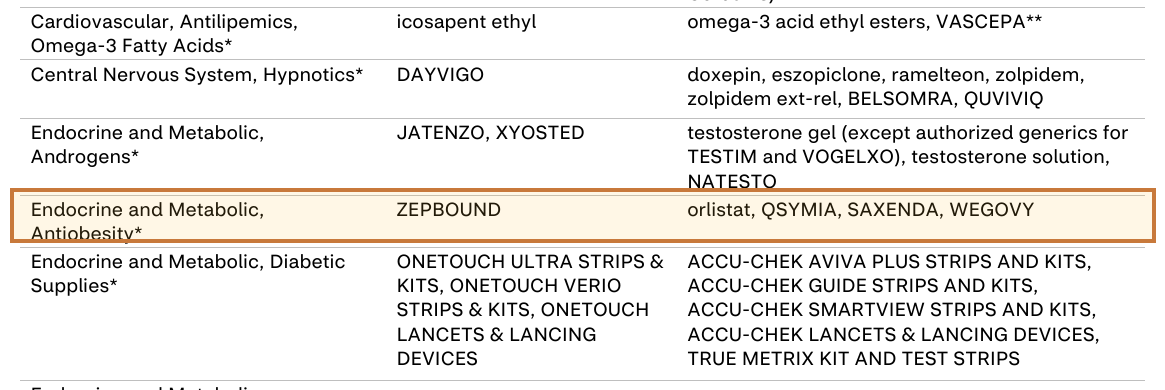
Two details in that notice matter for what you do next. First, the removal applies to Aetna's standard plan formulary — self-funded employers can and do keep their own drug lists, which is why some coworkers with "Aetna" cards still get Zepbound covered. Second, Wegovy stayed. If your goal is any covered GLP-1 rather than tirzepatide specifically, switching medications is usually a faster path than fighting for an exception. Your prescriber can cite your documented response to therapy either way.
If your coverage just stopped: the transition plan
The hardest version of Aetna's change is losing Zepbound coverage mid-titration — you're at 10 mg, it's working, and the September fill comes back rejected. Three things to know before you decide anything.
First, ask your prescriber about a transition plan rather than stopping outright: discontinuing a GLP-1 abruptly commonly leads to weight regain, and your clinician may prefer moving you to a covered alternative over a gap. Second, if you switch to Wegovy under Aetna's coverage, your history transfers better than most people expect — Aetna's own policies measure baseline BMI "at the start of any drug therapy," so the qualification you earned for Zepbound carries to the Wegovy PA, and your documented response to therapy strengthens the request. Third, if you'd rather stay on tirzepatide and pay cash, several telehealth programs will honor an existing dose with proof (a prescription record or the labeled box); our provider matcher flags which programs publish transfer policies and which leave it unverified, so you know what to confirm before paying.
What rarely works: appealing the removal itself. A formulary decision is not a claims decision — the winning moves are the exception request (with documented failure on the listed alternatives), the OSA pathway below, or a deliberate switch.
Coverage for weight loss: the PA criteria
Prior authorization is Aetna's pre-approval process: your prescriber submits documentation proving you meet the policy criteria before the pharmacy can fill Zepbound. On plans that kept the drug, Aetna's current policy (6947-C, P04-2025 revision) grants weight-loss authorization when all of the following hold:
- You have "participated in a comprehensive weight management program that encourages behavioral modification, reduced-calorie diet, AND increased physical activity with continuing follow-up for at least 6 months prior to using drug therapy."
- Your baseline BMI is 30 or higher — or 27 or higher with at least one weight-related comorbid condition (the policy's examples: hypertension, type 2 diabetes, dyslipidemia).
- Documentation for each point. The policy is explicit: "Documentation is required for approval."
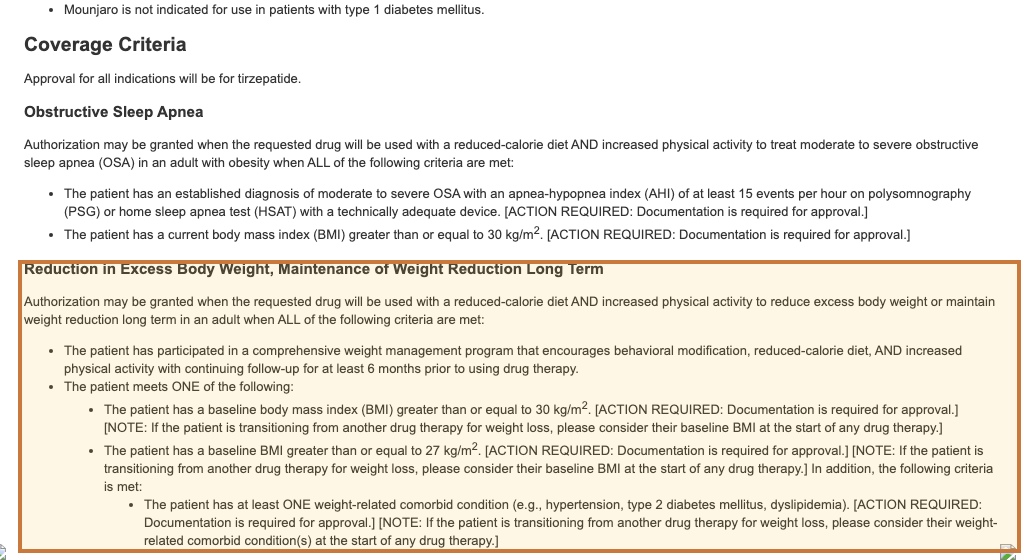
One clause works in your favor if you're switching from another GLP-1: baseline BMI counts from "the start of any drug therapy." Losing weight on Wegovy does not disqualify you from Zepbound — bring the chart note showing your starting BMI.
Initial weight-loss approval runs 8 months. Quantity limits allow one package (4 pens or 4 single-dose vials) per 21 days at each strength.
On timing: once your prescriber submits the PA with complete documentation, standard decisions typically come back within days to two weeks, and your prescriber can request an expedited review when a treatment gap poses risk. The single biggest cause of slow approvals is an incomplete first submission — confirm the 6-month program records and baseline BMI note went in with the request, because each resubmission restarts the clock.
Does Aetna cover Zepbound for sleep apnea?
Zepbound is FDA-approved for moderate-to-severe obstructive sleep apnea in adults with obesity, and Aetna's 6947-C policy covers that use on its own criteria: "an apnea-hypopnea index (AHI) of at least 15 events per hour on polysomnography or home sleep apnea test" plus a current BMI of 30 or higher. Initial OSA approval runs 6 months, renewals 12.
This pathway matters because it does not depend on your employer's weight-loss rider. A plan that excludes weight-loss drugs can still cover Zepbound for OSA — the diagnosis, not the benefit election, is the gate. If you snore heavily, wake unrefreshed, or a partner reports apneas, a sleep study is worth discussing with your doctor regardless of the insurance angle. Roughly speaking, this is the one door the July 2025 change didn't touch.
How to check your specific plan
There is no single Aetna answer on Zepbound — the plan document decides, and that's true across every plan type: PPO, HMO, POS II, EPO, Open Access, and administered variants like Meritain, Banner|Aetna, or the NC State Health Plan all follow whatever formulary their sponsor elected. Three ways to get your answer, fastest first:
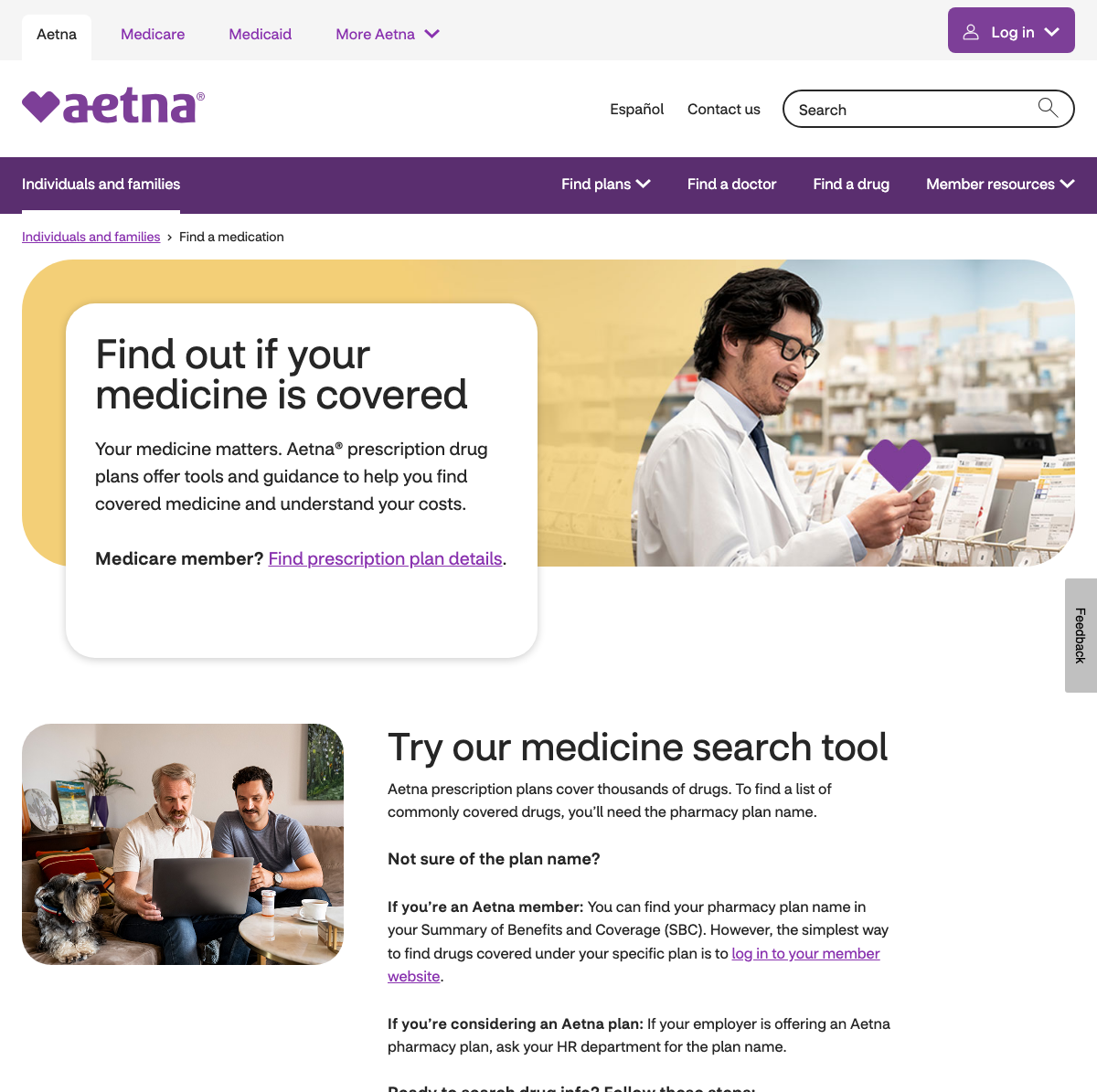
- Use Aetna's own drug lookup. Aetna's find-a-medication tool checks a drug against your plan's formulary once you select your plan or log in.
- Call the member line (number on your card) and ask three questions in order: "Is Zepbound on my plan's formulary? If yes, what prior authorization criteria apply? If no, does my plan cover any exception process?" Write down the representative's name and the reference number — you'll want them if a denial gets appealed later.
- Ask HR one question: "Did our plan keep weight-loss drug coverage, and does it include tirzepatide?" Self-funded employers own this decision, and benefits teams answer it routinely during open enrollment.
If you'd rather read than call: in your plan's Summary Plan Description or certificate of coverage, search for "weight loss" and "anti-obesity" — exclusion language lives under those exact phrases. A plan that excludes the class entirely will say so there, and that tells you the appeal route (exception request) before you burn weeks on a PA that can't succeed.
How long approvals last: the renewal rules
Getting Zepbound approved once is not the end. To continue past the initial 8 months, Aetna's 6947-C requires that you have "completed at least 3 months of therapy … at a stable maintenance dose" and "lost at least 5 percent of baseline body weight OR … continued to maintain their initial 5 percent weight loss."
The practical move: have your prescriber record weight at every visit from day one. The renewal denial we see most often in user reports isn't about the 5% — it's about the 5% not being documented anywhere the insurer accepts. A dated chart note beats a home-scale screenshot.
If you're denied: exceptions and appeals
If Aetna rejects your Zepbound claim, first find out which case you're in. A formulary exclusion (drug not on the list) and a PA denial (drug listed, criteria not met) have different fixes.
- PA denial: request the denial reason in writing, then file an internal appeal with the missing piece — usually the 6-month program documentation or the baseline BMI note. If the internal appeal fails, every state gives you external review rights by an independent physician.
- Formulary exclusion: appeals rarely overturn an exclusion. Your realistic options are a formulary exception request (strongest when you've failed the listed alternatives — document why Wegovy or Saxenda didn't work), the OSA pathway if the diagnosis fits, or switching to a covered alternative.
For a formulary exception request, three elements do most of the work: a statement of medical necessity from your prescriber naming why the listed alternatives are inappropriate for you specifically; documentation of any trial and failure on Wegovy or Saxenda (dates, doses, outcome, side effects); and your baseline records — starting BMI, comorbidity diagnoses, and the 6-month program history. Aetna's internal appeal decisions typically carry a deadline of 30 days for pre-service requests; if the denial stands, external review by an independent physician is your legal right in every state, and it reverses insurer denials often enough that it is worth the paperwork.
The honest limitation: we can read Aetna's policies, but not your plan document. Nothing here overrides what your employer's certificate of coverage says.
Cost with and without coverage
Aetna's coverage language hides the number that matters: your monthly out-of-pocket for Zepbound. Here is the realistic range on each path as of July 2026, using prices we verify and date on our provider pages.
| Path | Your monthly cost | Notes |
|---|---|---|
| Covered with PA (kept-rider plan) | Plan copay, commonly $25–$100+ by tier | Your Summary of Benefits lists the exact tier copay; quantity limits apply |
| Medicare GLP-1 Bridge | $50 flat | KwikPen only; does not count toward the Part D deductible or out-of-pocket cap |
| Cash pay, telehealth programs | ~$299–$449 + program fees | Advertised prices often exclude membership; verified fee breakdowns on our provider comparison |
| Cash pay, retail pharmacy list price | ~$1,000–$1,400 | The price nobody should pay — LillyDirect and telehealth routes undercut it |
How to get Zepbound without insurance
Without insurance, telehealth programs sell branded Zepbound from roughly $299–$449 per month depending on dose and program — plus membership fees that vary widely, which is where advertised prices get misleading. Our provider matcher filters verified programs by budget and whether they help with prior authorization paperwork, and the provider comparison shows every fee separated, with dates and sources. If you're weighing a specific quote, the cost calculator adds the membership fee programs tend to leave out of headlines.
FAQ
Does Aetna cover Zepbound for weight loss?
On most plans, no — Zepbound left Aetna's standard formulary on July 1, 2025. It's covered only if your employer's plan kept it, and then under policy 6947-C's criteria: a 6-month lifestyle program plus BMI ≥ 30, or ≥ 27 with a comorbidity.
Does Aetna Medicare cover Zepbound?
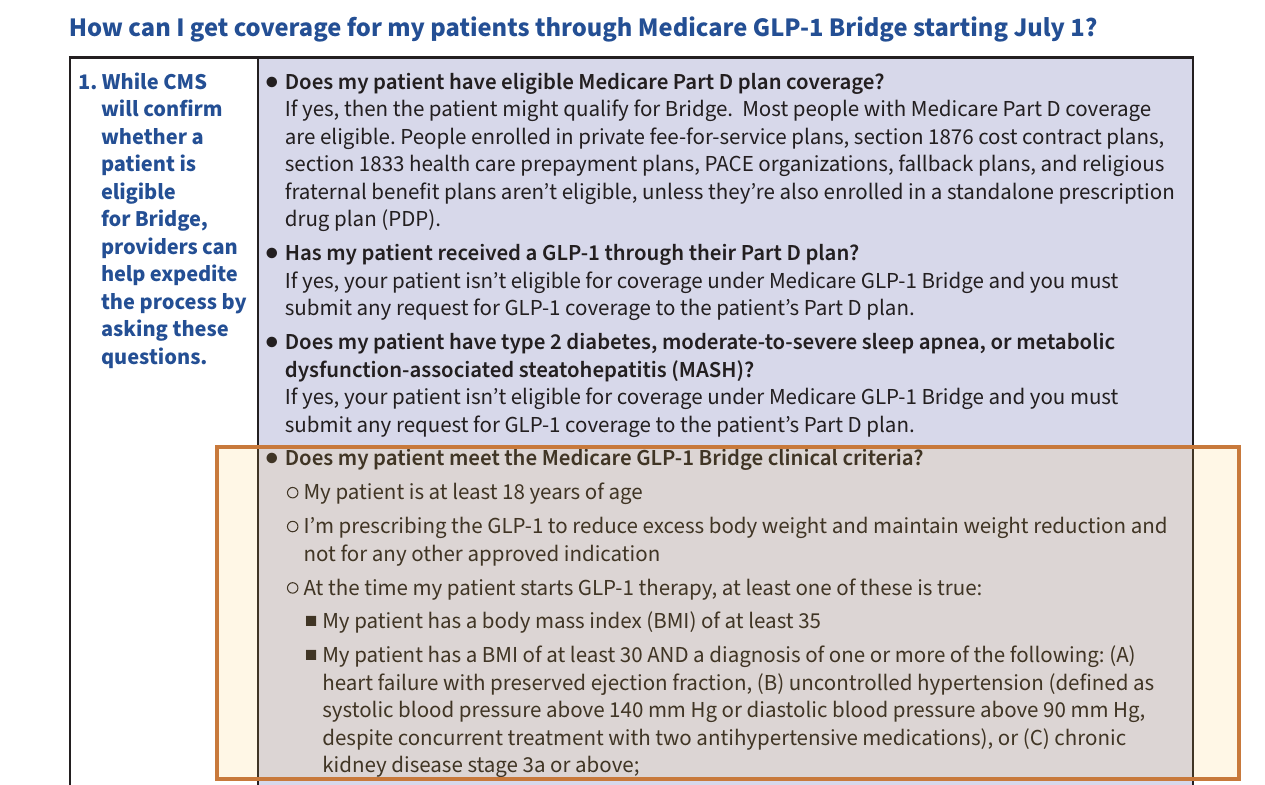
Part D can't cover weight-loss use by law, but the Medicare GLP-1 Bridge covers Zepbound KwikPen at a $50 monthly copay through December 31, 2027 for Part D enrollees meeting BMI criteria (35+, or lower with specific conditions). The claim runs outside your Aetna Part D plan: the pharmacy routes it to a CMS central processor with an obesity diagnosis code, and the prior-authorization request reaches your prescriber within 24–72 hours. Details are on our coverage checker under Medicare.
Are Zepbound vials covered the same as pens?
Under Aetna's commercial policy, quantity limits cover both pens and single-dose vials. The Medicare Bridge differs: it covers only the KwikPen — CMS states the single-dose pen and vials are not covered.
Was Zepbound covered by Aetna before July 2025?
Yes — Zepbound sat on Aetna's standard formulary with prior authorization through June 30, 2025, under the same BMI and 6-month-program criteria. The July 1, 2025 pharmacy change notice removed it from the standard list; earlier approvals ran until their authorization end date.
Does Aetna Better Health (Medicaid) cover Zepbound?
State-dependent. Aetna Better Health publishes anti-obesity criteria per state Medicaid program, and most state Medicaid programs still don't cover GLP-1s for obesity — 13 states did as of January 2026. Check your state's preferred drug list, or our checker under Medicaid.
Is Wegovy still covered by Aetna?
Yes. The July 2025 change kept Wegovy (and Saxenda) on the standard formulary, with prior authorization under the same BMI and 6-month-program structure. Our Aetna and Wegovy guide quotes the criteria from all three published policies, including the renewal checkpoint and the quantity limits.
Sources and update history
Primary documents, archived in our research records on July 22, 2026: Aetna pharmacy clinical policy 6947-C (P04-2025 revision); Aetna standard-plan change notice effective July 1, 2025; CMS Medicare GLP-1 Bridge program page. Policies change quarterly — verify against the linked documents and your plan papers.