Northwest criteria, effective June 2026
Does Kaiser Cover Ozempic in 2026?
Yes, but through the tightest criteria of any plan we have documented — and you have to fail several cheaper drugs first. Kaiser Permanente runs Ozempic through a Criteria-Based Consultation Prescribing Program rather than an ordinary formulary listing, and the ladder in front of it is long.
These are the Northwest region's criteria, revised April 9, 2026 and effective June 4, 2026, archived on July 26. Kaiser regions publish separately, so confirm yours — but the structure is instructive wherever you are.
- Three routes in: type 2 diabetes plus clinical ASCVD, type 2 diabetes with step therapy, or type 2 diabetes plus proteinuria.
- The main route requires at least two of metformin, a sulfonylurea, pioglitazone or an SGLT-2 for three months — plus maximum tolerated liraglutide.
- Your A1c must be above 6.9% and below 10%. There is an upper bound as well as a lower one.
- A personal or family history of medullary thyroid carcinoma or MEN 2 rules it out entirely.
- For weight loss without the benefit, members "pay member cash price" — compare that against the open market first. How we make money.
Does Kaiser cover Ozempic?
For type 2 diabetes, yes, if you clear one of three routes. For weight loss, only if your plan bought the weight-loss medication benefit — and Kaiser states the alternative bluntly.
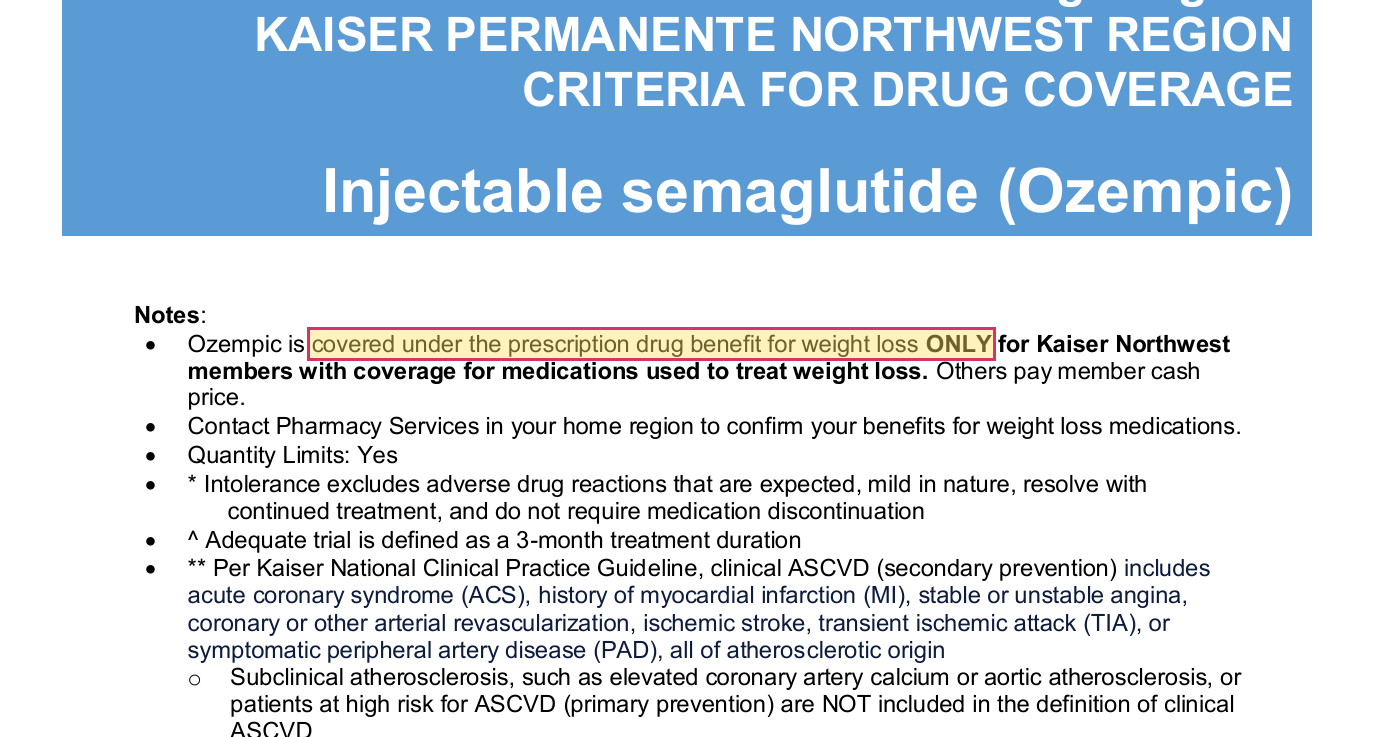
"Others pay member cash price" is worth taking literally. It is not a denial you appeal; it is a price list. Whether that price beats the open market is a question you can answer in a couple of minutes, and often it does not.
The ladder in front of the drug
The route most people fall under is the second one: adults aged 20 or older with type 2 diabetes, not on high-dose insulin. It requires more prior therapy than any other policy in our set.
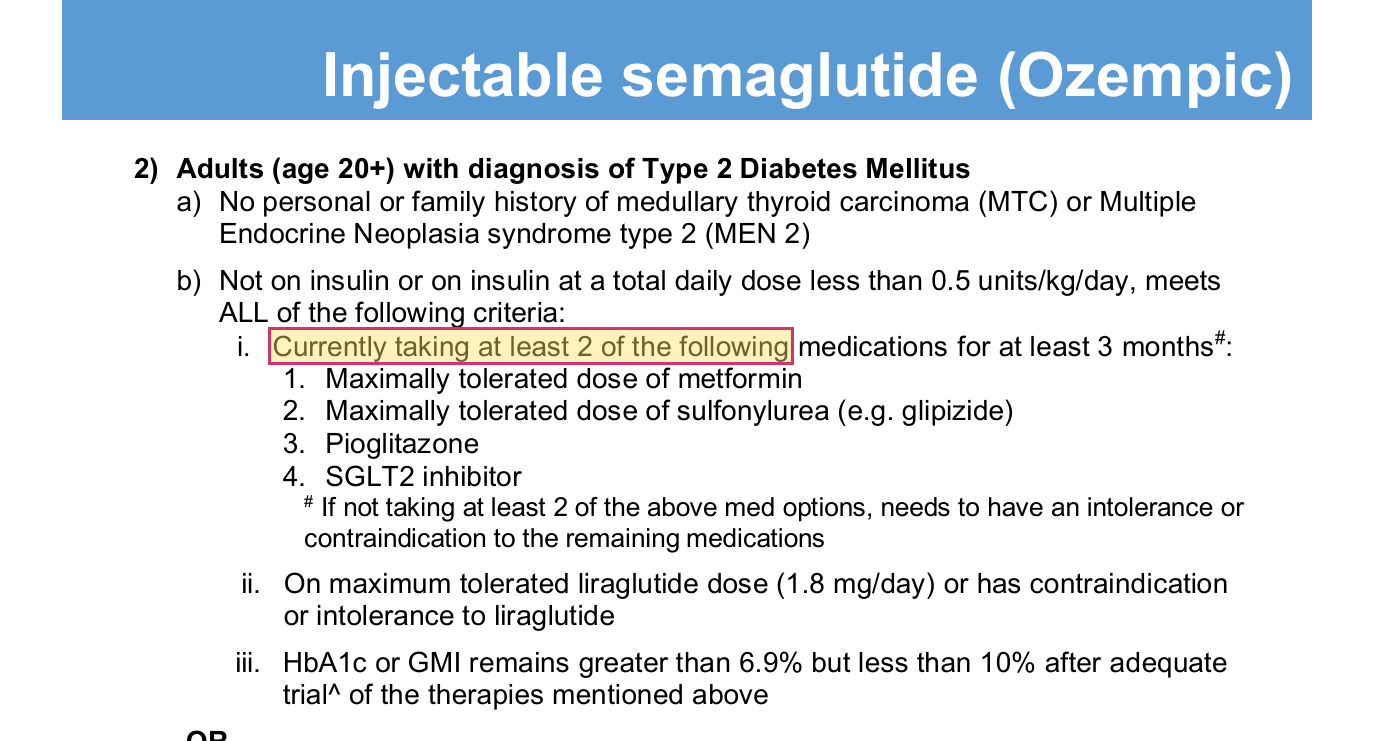
Read the two requirements as stacked rather than alternative. You need two of the four oral agents at maximally tolerated doses for at least three months, and if you are not on two of them you must have a documented intolerance or contraindication to the rest. On top of that, you need to be on maximum tolerated liraglutide at 1.8 mg/day, or have a contraindication or intolerance to it.
Liraglutide is itself a GLP-1. Kaiser is effectively requiring you to fail a cheaper GLP-1 before it will pay for this one.
The A1c window has a ceiling
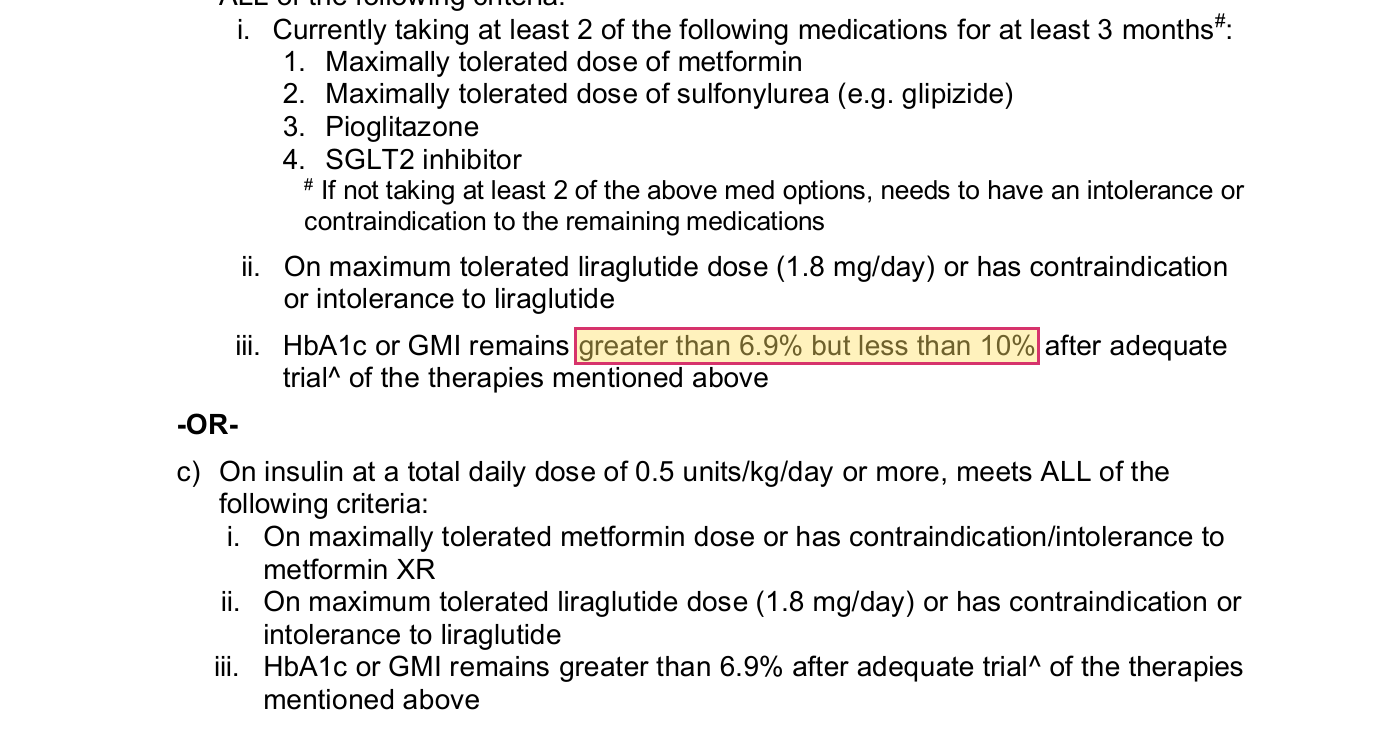
Almost every criteria document sets a floor. This one sets a ceiling too. An A1c of 11% does not qualify under this route, presumably because Kaiser considers a different treatment intensification appropriate at that level. "Adequate trial" is defined in the document as three months, and GMI means the estimated A1c derived from continuous glucose monitoring, so CGM data counts.
On high-dose insulin — 0.5 units per kilogram per day or more — a separate branch applies with a simpler test: maximally tolerated metformin, maximum tolerated liraglutide, and an A1c or GMI still above 6.9%, with no upper bound stated.
The exclusions and the ASCVD definition
Two details will decide some readers' cases before any of the above matters.
A personal or family history of medullary thyroid carcinoma or MEN 2 syndrome appears as a disqualifier on every route. It is a labelled contraindication for this drug class rather than a Kaiser invention, but Kaiser puts it first in the criteria, and a family history you have not mentioned to your prescriber is worth raising.
And if you are pursuing the cardiovascular route, Kaiser defines clinical ASCVD narrowly: acute coronary syndrome, prior myocardial infarction, stable or unstable angina, coronary or other arterial revascularization, ischemic stroke, transient ischemic attack, or symptomatic peripheral artery disease. The document then says explicitly that subclinical atherosclerosis — elevated coronary artery calcium, aortic atherosclerosis — and high-risk primary prevention are not included. A calcium score is not a ticket.
If the goal is weight loss
Then Ozempic is the wrong drug to push for at Kaiser, twice over: the criteria above are all built on a diabetes diagnosis, and the weight-loss benefit is a separate plan election your employer either bought or did not.
Where the benefit exists, Kaiser applies its own criteria to the weight-management drugs, and they carry their own step requirement — an adequate trial of the formulary alternative first. Where it does not exist, you are at member cash price, which is the point at which comparing against cash-pay telehealth becomes the only useful exercise.
What to bring to the appointment
- Your medication history with dates. Two oral agents at maximally tolerated doses for three months is a documentation question before it is a clinical one.
- Your liraglutide history, or the reason there is not one. This is the requirement most people do not see coming.
- A recent A1c or CGM-derived GMI. Check it falls inside the band rather than just above the floor.
- Any family history of thyroid cancer or MEN 2. Raise it early rather than late.
FAQ
Why does Kaiser require liraglutide before Ozempic?
Liraglutide is an older, cheaper GLP-1. The criteria require maximum tolerated liraglutide at 1.8 mg/day, or a documented contraindication or intolerance, before Ozempic is approved on the main diabetes route.
Does Kaiser cover Ozempic for weight loss?
Only for members whose plan includes coverage for weight-loss medications. Kaiser states that others pay the member cash price.
What A1c do I need for Kaiser to cover Ozempic?
On the main route, above 6.9% and below 10% after an adequate trial of the required prior therapies. A CGM-derived GMI counts in place of a lab A1c.
Does a high coronary calcium score qualify me?
No. Kaiser's definition of clinical ASCVD explicitly excludes subclinical atherosclerosis such as elevated coronary artery calcium, and excludes high-risk primary prevention.
Do these criteria apply to every Kaiser region?
These are the Northwest region's. Kaiser regions publish their own criteria documents, so confirm with pharmacy services in your home region.
Sources and update history
Primary document, archived July 26, 2026: Kaiser Permanente Northwest, Criteria for Drug Coverage — injectable semaglutide (Ozempic), revised 4/9/2026, effective 6/4/2026. Other Kaiser regions publish separately. Companion pages: Cigna and Ozempic, Blue Cross and Ozempic, TRICARE and Ozempic.