33 independent plans — the answer depends on which Blue you have
Does Blue Cross Blue Shield Cover Zepbound in 2026?
There is no Blue Cross Blue Shield answer — there are 33 of them. BCBS is a federation of independent companies, each setting its own formulary, and 2026 is the year their answers split hard: Blue Cross Blue Shield of Massachusetts ended weight-loss GLP-1 coverage entirely at plan renewal, BCBS North Dakota removed the drugs from fully insured large-group plans, Blue Cross NC lists Zepbound as "not covered as a standard benefit," while Anthem's 2026 formularies still list it — behind a flag that means your employer decides. Federal employees are on a different system again, with a Zepbound-specific policy that adds step therapy.
We archived each of those primary documents on July 22, 2026 and quote them below. Start by finding your situation:
| Your card says | Status | Details below |
|---|---|---|
| Anthem (14 states) | On formulary, Tier 2, PA + quantity limit — but benefit-exclusion flagged: covered only if your employer bought weight-loss benefits | Anthem section |
| BCBS Massachusetts | Excluded at plan renewal from January 1, 2026 (T2D GLP-1s unaffected); employers with 100+ employees can buy continued coverage | 2026 changes |
| Blue Cross NC | "Not covered as a standard benefit" — coverage only if your group elected it | 2026 changes |
| BCBS North Dakota | Removed from fully insured large-group plans at 2026 anniversary; individual/small-group metallic plans keep it under state EHB rules | 2026 changes |
| FEP (federal employees) | Covered with PA under Zepbound policy 5.99.031: BMI criteria plus step therapy through two oral medications | FEP section |
| Other state Blues | Plan-by-plan — most cover with PA only when the employer includes the benefit | How to check |
Which Blue Cross do you have? Start here
The single most useful thing you can do takes ten seconds: read the front of your card. The licensee name printed there — Anthem, Highmark, Florida Blue, CareFirst, Blue Cross Blue Shield of Massachusetts, Blue Cross NC — is the company whose formulary decides your case, and "Blue Cross covers it in my state" from a forum post about a different Blue tells you nothing. Two more distinctions matter: a suitcase icon with "PPO" means you may be using another state's network while your home Blue still sets drug coverage; and if you or a family member is a federal employee, your coverage is FEP — a national program with its own policies, covered below.
Whichever Blue you have, the pattern of 2026 is the same pattern we document across insurers: the clinical criteria are the easy part, and the real gate is whether your employer's plan includes weight-loss drug benefits at all. The Blues just made that gate more visible this year.
Does Anthem Blue Cross cover Zepbound?
On paper, yes: Anthem's 2026 Essential drug list (the fully insured formulary, effective July 1, 2026) lists Zepbound at Tier 2 with the codes "PA; BE; QL" — prior authorization, benefit exclusion, quantity limit. That middle code is the one that decides your case. Anthem's own legend: "BE = benefit exclusion. This drug may not be covered depending on your plans design."
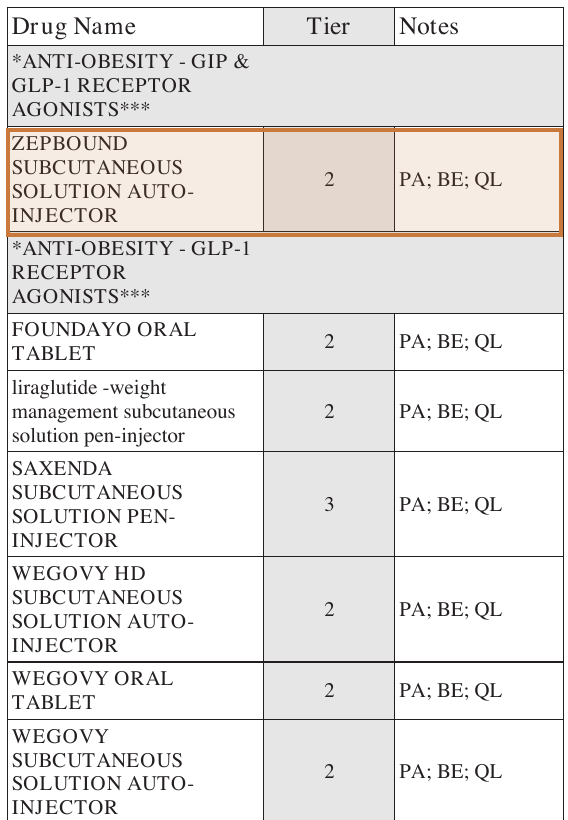
Translated: Anthem will cover Zepbound with prior authorization and quantity limits if your employer's plan design includes weight-loss drugs; the same formulary line is a dead end if it doesn't. Anthem publishes no single public criteria document for commercial Zepbound PA — the fastest way to your answer is the Sydney app or anthem.com's "Price a Medication," which reads your actual plan design. Two Anthem lines to know: Anthem Medicare Advantage doesn't cover weight-loss use (federal Part D exclusion — the Medicare Bridge is the route instead), and Anthem's Medicaid criteria are state-set and much stricter where they exist at all — California's Medi-Cal removed Zepbound for weight loss on January 1, 2026, keeping only a sleep apnea carve-out.
Federal employees: the FEP policy
The Federal Employee Program gave Zepbound its own policy for 2026 — 5.99.031, effective January 1, 2026 — and it's stricter than most state Blues' criteria in one specific way. Beyond the standard BMI gate (30+, or 27+ with established cardiovascular disease or a weight-related comorbidity) and a comprehensive weight-management program, FEP requires "inadequate treatment response, intolerance, or contraindication to at least TWO oral medications for weight management (e.g., benzphetamine, diethylpropion, phentermine, Qsymia, etc.)" — plus trying the formulary's preferred products first unless there's a documented medical exception.
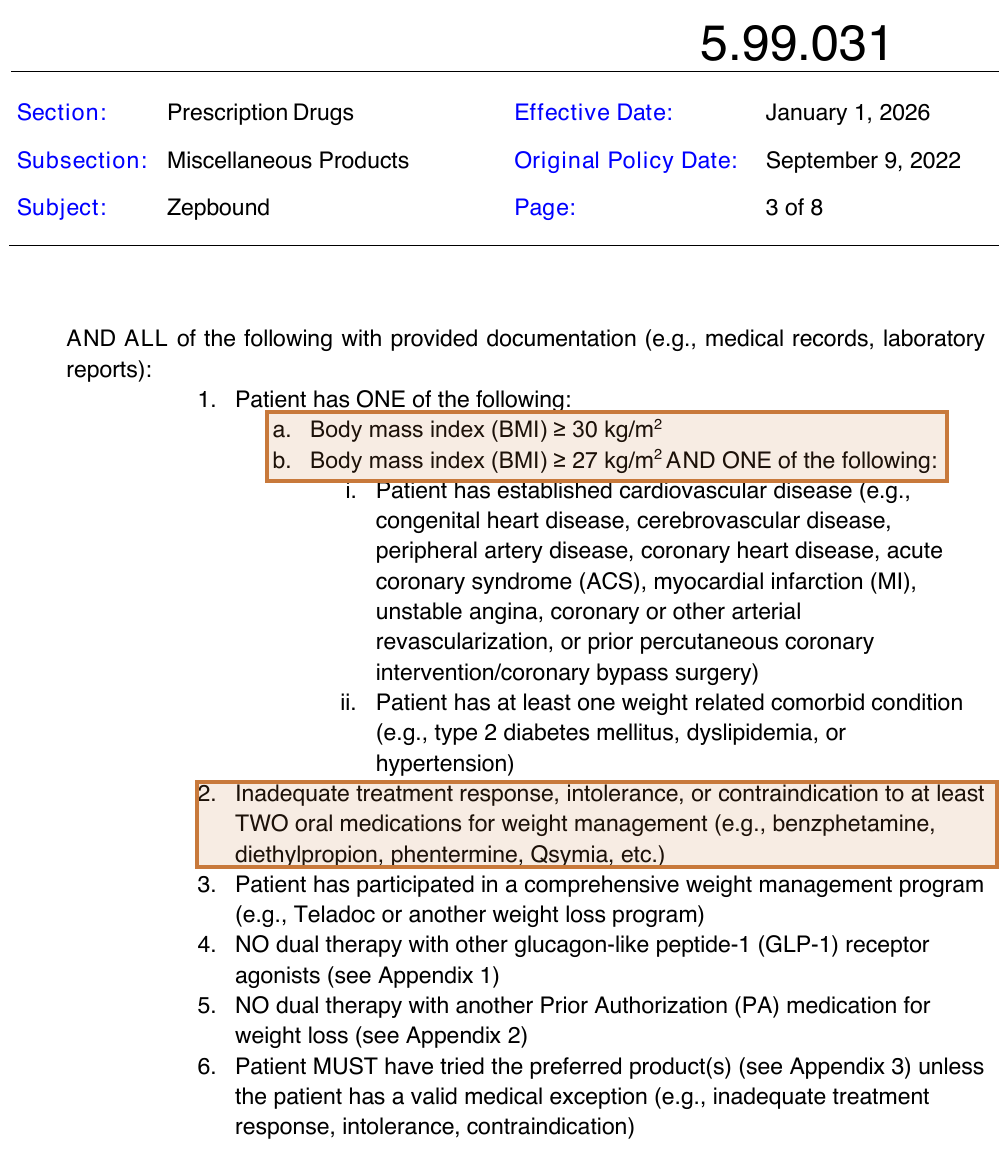
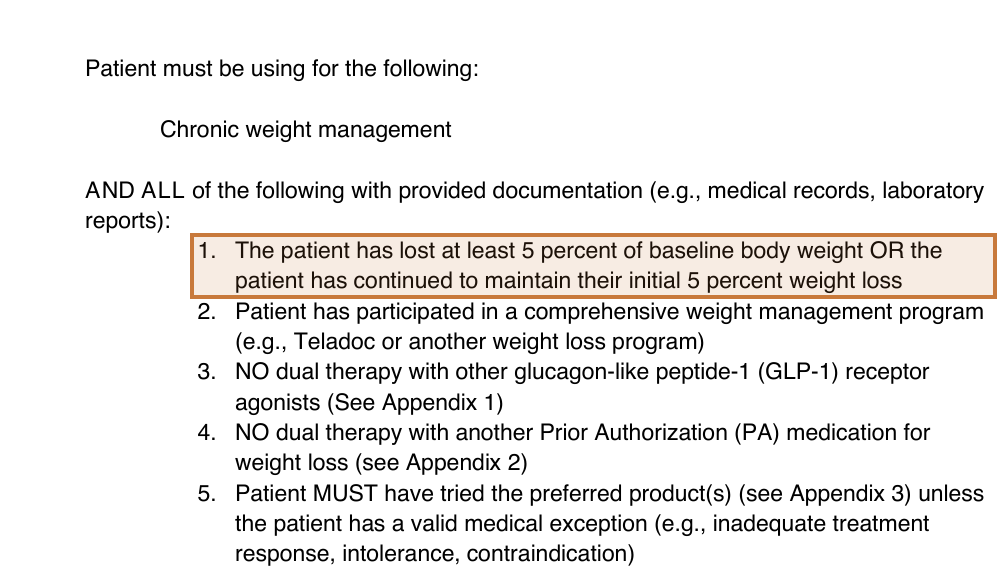
That step-therapy line is the one that surprises people: on FEP, a first-time GLP-1 request without documented trials of two older oral drugs gets denied on criteria, not on judgment. If phentermine or Qsymia is contraindicated for you (uncontrolled hypertension is a common reason), have your prescriber document the contraindication — it satisfies the requirement without a failed trial. Approvals run 6 months initially, then 12-month renewals for patients who have "lost at least 5 percent of baseline body weight" or maintained that initial loss:
Coverage for weight loss vs. sleep apnea
Zepbound has two FDA indications, and on the Blues they increasingly get opposite answers. The 2026 exclusions target weight-loss use; obstructive sleep apnea is a separate clinical indication, and some plans that dropped the weight-loss benefit still review OSA requests. The clearest documented example: when California's Medi-Cal removed Wegovy, Zepbound, and Saxenda for "weight loss or weight-loss indications" on January 1, 2026, the same bulletin says prior authorization will still be considered for "Zepbound when used for obstructive sleep apnea (OSA)." FEP's 5.99.031 likewise lists moderate-to-severe OSA in adults with obesity as a covered indication.
The practical rule: if you have a sleep study showing moderate-to-severe OSA (an apnea-hypopnea index of 15 or more), have your prescriber lead with that diagnosis, not weight loss — it can route your request through a door the exclusion never touched. But don't assume every Blue kept that door open: Massachusetts' exclusion language covers its weight-loss GLP-1 list without publishing an OSA carve-out, so ask your specific plan the question directly: "Is Zepbound coverable under my plan for obstructive sleep apnea with prior authorization?"
What the state Blues changed for 2026
Three Blues' 2026 decisions rank on this question, and each is worth quoting exactly, because the wording tells you what recourse you have.
Massachusetts — BCBS MA ended GLP-1 coverage for weight loss at plan renewal: "upon plan renewal starting January 1, 2026, Wegovy, Saxenda, and Zepbound will no longer be covered, even if you're currently using them." Type 2 diabetes GLP-1s (Ozempic, Mounjaro, Trulicity) are unaffected. Two mechanics matter: employers with more than 100 employees can pay to continue coverage — smaller groups and direct-pay members cannot — and the change cannot be appealed; BCBS MA's own FAQ says "No. This is a benefit exclusion that can't be appealed." Existing prior authorizations end at your plan's renewal date, not January 1, so your personal deadline is your renewal month.
North Dakota — BCBSND removed weight-loss drugs (naming Wegovy, Saxenda, and Zepbound) from fully insured large-group plans "starting Jan. 1, 2026 upon plan anniversary." Self-funded employers must now opt in. The carve-out: individual and small-group metallic plans keep coverage under North Dakota's Essential Health Benefit requirements — one of the few states where state law overrides the retreat. BCBSND's stated reason is the cost curve: spending on these drugs grew 46% in 2025, toward an estimated $23 million for its commercial plans.
North Carolina — Blue Cross NC's prior-authorization reference lists Zepbound (with Wegovy, Saxenda, Qsymia, and the older drugs) under "Not covered as a standard benefit," with coverage only where a group elected it: "Please see member guide for coverage." This isn't a 2026 change so much as the standard-exclusion model stated plainly — the same employer-rider mechanics as Anthem's BE flag, without the formulary listing.
If your Blue isn't one of these: the pattern still travels. The public documents to search for are your Blue's "formulary" plus "weight loss," and the phrases that decide your case are "benefit exclusion," "standard benefit," and "plan design."
How to check your plan
Three steps, fastest first, whichever Blue you have:
- Price the drug in your member portal (Sydney for Anthem, MyBlue for FEP and several states, or your Blue's own app). The price-a-medication tool reads your actual plan design — the same data the pharmacy sees — and shows the PA flag or the exclusion.
- Call the member line and ask three questions in order: "Does my plan include weight-loss drug benefits? Is Zepbound on my formulary? What prior authorization criteria apply?" Note the representative's name and reference number. Decision timelines are short once a complete PA goes in — Blue Cross NC, for example, commits to a decision "within 3 business days" of complete information, 24 hours for urgent requests.
- Ask HR one question: "Did our plan keep weight-loss drug coverage for 2026 — and will it for 2027?" After Massachusetts made continued coverage a paid buy-up for large employers, that second half of the question is no longer paranoid; benefit elections happen every fall.
If you're denied
The denial letter's wording tells you which of two very different situations you're in — and the Blues' own documents draw the line explicitly.
- PA denial (drug covered, criteria not met): fixable. The usual missing pieces are the baseline BMI chart note, comorbidity documentation for the 27–30 band, the weight-management program record — or, on FEP, the two-oral-drug step therapy history. Resubmit with the missing document; if it fails, internal appeal, then external review by an independent physician, which every state provides.
- Benefit exclusion (your plan doesn't include the benefit): not appealable — Massachusetts says so in as many words. Your real options: the OSA pathway above if the diagnosis fits, your employer's buy-up election at open enrollment (worth one email to HR — MA employers over 100 employees literally can purchase it back), state-mandate carve-outs like ND's metallic plans if you're shopping individual coverage, or cash pay.
On cash pay: telehealth programs sell branded Zepbound at roughly $299–$449 a month plus program fees — a fraction of the ~$1,000–$1,400 retail list price. Our provider matcher filters verified programs by budget and prior-auth help, and the cost calculator adds the membership fees advertised prices leave out.
FAQ
Does Blue Cross Blue Shield cover Zepbound for weight loss?
It depends on which of the 33 Blues you have and what your employer elected. In 2026, BCBS Massachusetts excludes it at renewal, BCBSND removed it from fully insured large-group plans, Blue Cross NC treats it as non-standard, Anthem covers it with PA only where the plan design includes weight-loss drugs, and FEP covers it with PA plus step therapy.
Does Anthem Blue Cross cover Zepbound in 2026?
Anthem's 2026 formularies list Zepbound at Tier 2 with PA and quantity limits, flagged "BE" — benefit exclusion — meaning it's covered only if your employer's plan design includes weight-loss benefits. Check "Price a Medication" in the Sydney app for your plan's answer.
Does BCBS Federal (FEP) cover Zepbound?
Yes, under policy 5.99.031: BMI ≥ 30 (or ≥ 27 with cardiovascular disease or a comorbidity), a weight-management program, and documented failure, intolerance, or contraindication to at least two oral weight-loss medications. 6-month initial approvals, 12-month renewals at 5% weight loss.
Does Blue Cross cover Zepbound for sleep apnea?
Increasingly, this is the surviving pathway: FEP covers the OSA indication, and California's Medi-Cal kept an OSA carve-out even while removing weight-loss coverage. Not every Blue publishes its answer — ask your plan specifically about OSA coverage with prior authorization.
My BCBS plan covered Zepbound last year. Why did it stop?
Most likely your plan renewed into a 2026 exclusion (Massachusetts and North Dakota both tied removals to the renewal/anniversary date) or your employer dropped the weight-loss benefit at open enrollment. The denial letter will say whether it's a benefit exclusion — which can't be appealed — or a criteria denial, which can.
Do Blue Cross Medicare plans cover Zepbound?
Not for weight loss — federal law excludes it from Part D, and Anthem's Medicare policies verify a diabetes diagnosis for GLP-1s. The Medicare GLP-1 Bridge covers Zepbound KwikPen at $50/month through 2027 instead; see our Medicare page.
Sources and update history
Primary documents, archived in our research records on July 22, 2026: BCBS Massachusetts GLP-1 coverage update (change effective at plan renewal from January 1, 2026); BCBSND 2026 weight-loss drug changes (August 7, 2025); Blue Cross NC prior-authorization drug list; Anthem 2026 Essential Drug List (effective July 1, 2026); Anthem California GLP-1 coverage bulletin (November 14, 2025); FEP policy 5.99.031 — Zepbound (effective January 1, 2026). Not yet verified: whether BCBS MA's exclusion extends to the OSA indication. Policies change at plan renewal — verify against the linked documents and your plan papers.