Covered with prior authorization — if your plan bought the rider
Does United Healthcare Cover Zepbound in 2026?
UnitedHealthcare covers Zepbound with prior authorization — but only on plans that elected weight-loss drug coverage. UHC's own 2026 policy describes itself as "an optional program that is put in place for clients or businesses that have elected to cover weight loss products." If your employer bought that option, Zepbound is covered under the criteria below with a 6-month initial authorization. If your employer didn't, the same card gets a denial — and your realistic paths are the sleep apnea route, a state coverage mandate, the Medicare GLP-1 Bridge, or cash pay.
We archived UnitedHealthcare's current weight-loss prior authorization policy (program 2026 P 1114-21, effective July 1, 2026) on July 22, 2026. Everything below quotes that document — not a summary of a summary. The whole picture in one table:
| Path | Who qualifies | Status |
|---|---|---|
| Employer plan with the weight-loss rider | Plans that elected weight-loss drug coverage | Covered with prior authorization: BMI ≥ 30, or ≥ 27 with a comorbidity, plus lifestyle modification |
| State-mandated coverage | Fully insured plans in California, New Mexico, New York, and North Dakota EHB plans | Covered by regulation — the policy names all four states (North Dakota uses stricter criteria) |
| Sleep apnea pathway | Moderate-to-severe obstructive sleep apnea | Listed as a qualifying indication since the March 2025 policy update |
| Medicare GLP-1 Bridge | Part D enrollees meeting BMI criteria | $50/month copay through December 31, 2027 (KwikPen only) |
Does UHC cover Zepbound for weight loss?
Yes — when the plan includes the benefit, UnitedHealthcare approves Zepbound for weight loss based on all of the following, quoted from the 2026 policy:
- Treatment is requested "for appetite suppression or weight loss" (Zepbound also qualifies independently for moderate-to-severe obstructive sleep apnea — more on that below).
- You are older than 16.
- The drug is "used as an adjunct to lifestyle modification (e.g., dietary or caloric restriction, exercise, behavioral support, community-based program)."
- BMI of 30 or higher — or 27 or higher with "a weight-related comorbidity (e.g., dyslipidemia, hypertension, type 2 diabetes, sleep apnea)."
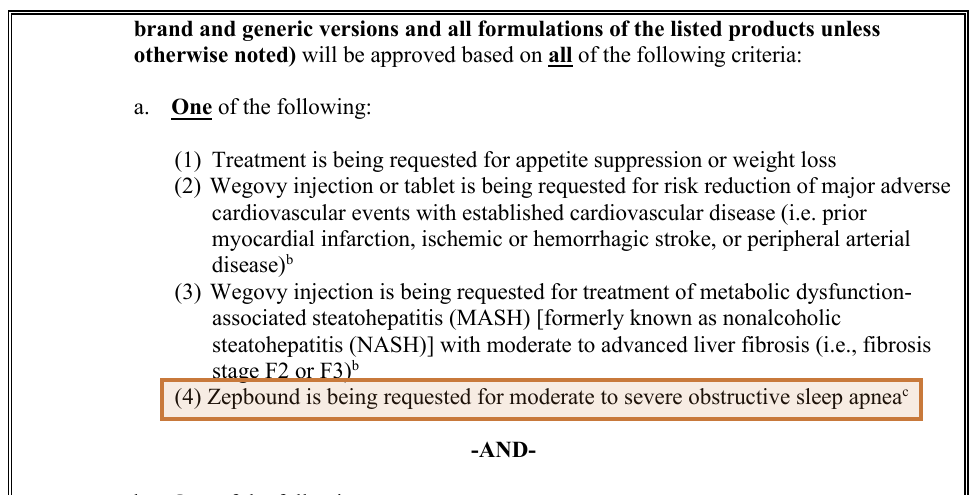
Note what is not on the list: there is no 6-month supervised diet requirement, which Aetna and the BCBS Federal Employee Program do impose. UHC asks that Zepbound be used alongside lifestyle modification, not that you document half a year of it first. In practice that makes a complete first submission easier — a chart note with your BMI, comorbidity diagnoses, and a documented lifestyle plan covers the criteria.
The optional rider: why identical cards get different answers
The single most confusing thing about UnitedHealthcare and Zepbound is that two people with identical-looking cards get opposite outcomes. The reason is in the policy's first paragraph: weight-loss coverage is an option employers buy, not a default. UHC's pharmacy benefit (administered through Optum Rx) applies these criteria only after your plan sponsor has elected the benefit.
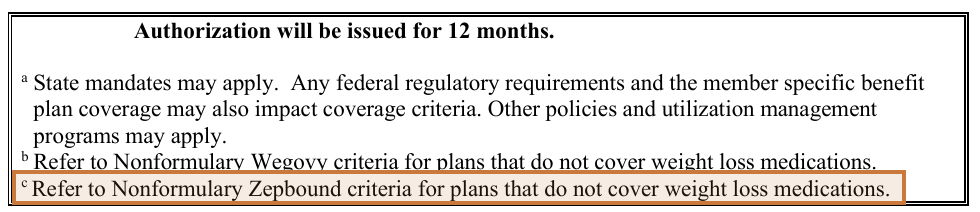
Two exceptions override the employer's choice. First, state mandates: the policy is "designed to meet regulatory requirements for coverage of weight loss medications in California, New Mexico, North Dakota Essential Health Benefits (EHB) and New York" — on fully insured plans in those states, the benefit exists by law (North Dakota's EHB version sets its own, stricter bar, starting at BMI ≥ 40 for adults). Second, the footnote above: even excluded plans have a separate "Nonformulary Zepbound" pathway, which is how sleep apnea cases get reviewed on plans that never bought the weight-loss rider. That nonformulary document sits behind UHC's provider login, so we can't quote its criteria — ask your prescriber to request it through the Optum Rx PA portal.
Coverage for sleep apnea
Zepbound is FDA-approved for moderate-to-severe obstructive sleep apnea in adults with obesity, and UnitedHealthcare added OSA as a qualifying indication in its March 2025 policy update. On plans with the weight-loss benefit, OSA is simply item (4) on the indication list — same BMI criteria, same durations. On plans without it, OSA review runs through the nonformulary pathway above.
If you have documented moderate-to-severe OSA (typically an apnea-hypopnea index of 15 or more on a sleep study), lead with that diagnosis rather than weight loss. It changes which policy your request is reviewed under, and a denial coded against a weight-loss exclusion is much harder to appeal than a clinical decision on an FDA-approved indication.
How to check your plan (Choice Plus, AARP, Community Plan)
The plan name on a UnitedHealthcare card — Choice, Choice Plus, Options PPO, Surest — describes the medical network, not the drug list. Whether Zepbound is covered depends on which prescription drug list (PDL) your plan uses and whether the weight-loss rider was elected. Three ways to find out, fastest first:
- Log in and price the drug. On myuhc.com or the UHC app, "Find and price a medication" checks Zepbound against your actual PDL and shows the PA flag. This is the same data the pharmacy sees.
- Call the number on your card and ask three questions in order: "Does my plan cover weight-loss medications? Is Zepbound on my prescription drug list? What prior authorization criteria apply?" Note the representative's name and reference number.
- Ask HR one question: "Did our plan elect weight-loss drug coverage?" Self-funded employers own this decision, and the benefits team answers it routinely.
Two card types follow different rules entirely. AARP / UnitedHealthcare Medicare plans: Part D can't cover weight-loss drugs by law, but the Medicare GLP-1 Bridge covers Zepbound KwikPen at a $50 monthly copay through December 31, 2027 — the claim runs outside your Part D plan through a CMS processor. UnitedHealthcare Community Plan (Medicaid): coverage is set by your state's Medicaid preferred drug list, not this policy; most state programs still exclude GLP-1s for obesity. Our coverage checker covers both cases.
The 6-month authorization: renewal rules
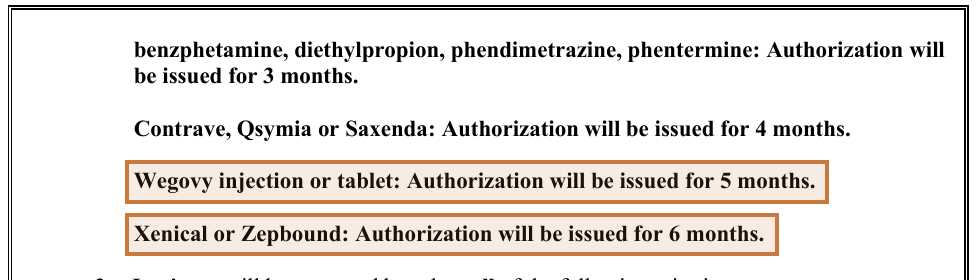
An approved Zepbound PA on UnitedHealthcare runs 6 months — one month longer than Wegovy's 5, a quirk of the policy worth knowing when you compare drugs.
To renew past the first 6 months, the policy requires "weight loss of ≥ 5% of baseline body weight" plus "continuation of lifestyle modification." Meet both and the reauthorization is issued for 12 months — a full year between paperwork rounds, which is friendlier than most insurers' cycles.
The practical move is the same one we give for every insurer: have your prescriber record your weight at every visit from day one. Five percent from baseline is a low bar on tirzepatide — clinical trials averaged far more — but the renewal fails if the number isn't documented somewhere UnitedHealthcare accepts. A dated chart note beats a home-scale screenshot.
If you're denied
First find out what kind of denial you got — the letter (or the pharmacist's rejection code) tells you which fix applies.
- PA denial on a plan with the benefit: something in the submission didn't meet criteria — usually a missing baseline BMI note, no comorbidity documentation for the 27–30 BMI band, or no lifestyle-modification record. Request the denial reason in writing, have your prescriber resubmit with the missing piece, and if it fails again, file an internal appeal. Past that, every state gives you external review by an independent physician.
- Benefit exclusion (your plan never bought the rider): appeals against the exclusion itself rarely work. The moves that do: the sleep apnea pathway if the diagnosis fits, the nonformulary Zepbound request through your prescriber, a state-mandate check if you're on a fully insured plan in California, New Mexico, New York, or North Dakota — and failing those, cash pay below.
For the resubmission, three documents do most of the work: a chart note with baseline BMI and the comorbidity diagnoses, the lifestyle-modification plan (a dietitian referral, program enrollment, or documented clinician counseling), and — if you're switching from another GLP-1 — records of your response to therapy. Incomplete first submissions are the biggest cause of slow approvals, and each resubmission restarts the clock.
Cost with and without coverage
UnitedHealthcare's coverage answer decides your monthly out-of-pocket for Zepbound. The realistic ranges on each path as of July 2026, using prices we verify and date on our provider pages:
| Path | Your monthly cost | Notes |
|---|---|---|
| Covered with PA (rider plan) | Plan copay, commonly $25–$100+ by tier | Your Summary of Benefits lists the exact tier copay |
| Medicare GLP-1 Bridge | $50 flat | KwikPen only; runs outside Part D and doesn't count toward its out-of-pocket cap |
| Cash pay, telehealth programs | ~$299–$449 + program fees | Advertised prices often exclude membership; verified fee breakdowns on our provider comparison |
| Cash pay, retail pharmacy list price | ~$1,000–$1,400 | The price nobody should pay — LillyDirect and telehealth routes undercut it |
If you land on cash pay, our provider matcher filters verified telehealth programs by budget and whether they help with prior authorization paperwork, and the cost calculator adds the membership fees programs tend to leave out of headlines.
FAQ
Does United Healthcare cover Zepbound for weight loss?
Yes, with prior authorization — on plans whose employer elected weight-loss drug coverage. Criteria: age over 16, lifestyle modification, and BMI ≥ 30 (or ≥ 27 with a weight-related comorbidity). Plans without the rider deny it regardless of criteria.
Does UHC Choice Plus cover Zepbound?
Choice Plus is a network type, not a drug list — some Choice Plus plans cover Zepbound and some exclude it, depending on whether the employer bought weight-loss coverage. Check "Find and price a medication" on myuhc.com for your plan's answer.
Does AARP UnitedHealthcare cover Zepbound?
Part D plans can't cover weight-loss drugs by law. The Medicare GLP-1 Bridge covers Zepbound KwikPen at a $50 monthly copay through December 31, 2027 for enrollees meeting BMI criteria — the claim bypasses your Part D plan via a CMS central processor. For sleep apnea, Part D can cover Zepbound normally, since that's not a weight-loss use.
Does UnitedHealthcare Community Plan cover Zepbound?
Community Plan is Medicaid, so your state's preferred drug list decides — most state Medicaid programs still exclude GLP-1s for obesity (13 states covered them as of January 2026). Check your state's list or our coverage checker.
How long does a UnitedHealthcare Zepbound approval last?
6 months initially. Renewals require ≥ 5% weight loss from baseline plus continued lifestyle modification, and are then issued for 12 months.
Does UnitedHealthcare cover Zepbound for sleep apnea?
Moderate-to-severe obstructive sleep apnea is a qualifying indication in the 2026 policy. On plans without weight-loss coverage, OSA requests run through a separate nonformulary Zepbound review — have your prescriber lead with the OSA diagnosis.
Sources and update history
Primary document, archived in our research records on July 22, 2026: UnitedHealthcare Pharmacy Prior Authorization/Notification — Weight Loss (program 2026 P 1114-21, effective July 1, 2026; OSA indication added in the March 2025 P&T update). Medicare figures: CMS Medicare GLP-1 Bridge program page. Not yet verified: the criteria inside UHC's login-walled "Nonformulary Zepbound" policy. Policies change quarterly — verify against the linked documents and your plan papers.